
Hack Trick Chicken Pirate – Do Any Methods Actually Work
When a Simple Interface Creates the Illusion of a Hidden System
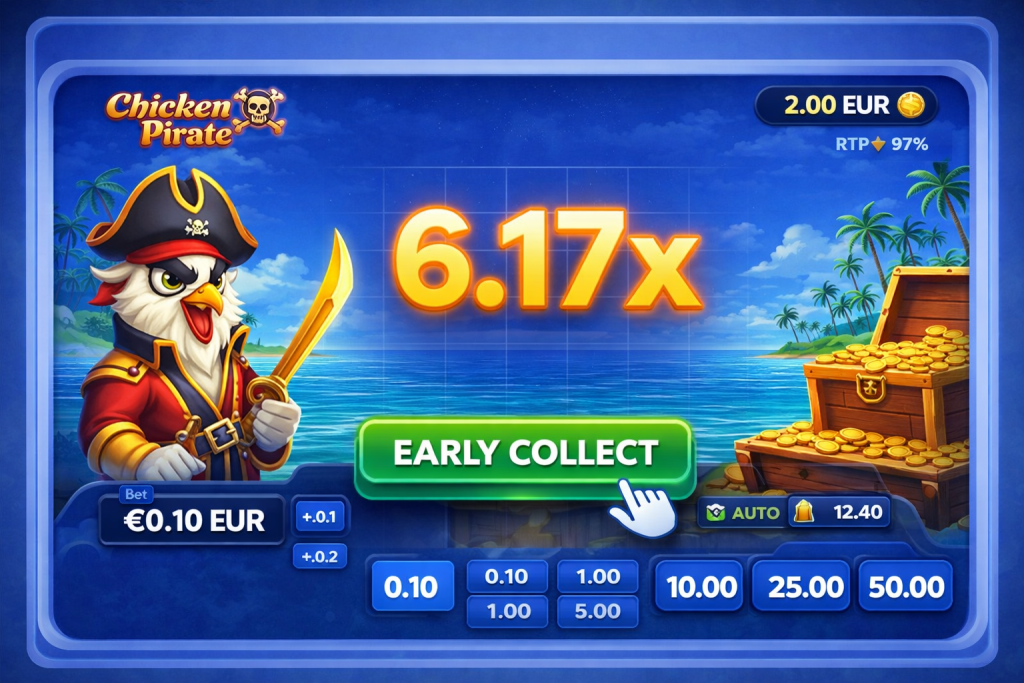
Chicken Pirate does not present itself as a traditional slot, and that distinction immediately shapes how players approach it. There are no reels to follow, no paylines to calculate and no symbol combinations to interpret. Instead, the entire experience is reduced to a rising multiplier, a single decision point and a sudden crash that can end the round without warning. This stripped-down structure makes the game feel transparent. It looks as if everything important is already visible, and that perception encourages players to believe that a hidden method must exist somewhere within that visibility.
The multiplier rises in real time, creating a continuous sense of movement and anticipation. The player is not waiting for a result to be revealed; the result appears to be unfolding in front of them. This difference is crucial. In many games, outcomes are delivered after a fixed sequence. In Chicken Pirate, the outcome feels like something that can be intercepted. The presence of a collect or cashout button reinforces that idea. It suggests that the player is not only observing the process but also participating in it at a decisive moment.
That participation is where the illusion begins. The player presses collect and secures a result, which creates a direct connection between action and outcome. It feels like control, even though the underlying system remains unchanged. Over time, repeated exposure to this loop encourages a subtle shift in thinking. Instead of seeing the game as a sequence of independent rounds, players begin to see it as a flow that can be read, timed and potentially influenced. This is the psychological opening through which the idea of a hack trick enters.
What Players Actually Mean When They Say “Hack Trick”
When players refer to a hack trick in Chicken Pirate, they are rarely talking about technical manipulation or external tools. The term is used more loosely. It usually describes a belief that there is a reliable way to interact with the multiplier that produces better outcomes over time. This belief can take several forms, but it tends to revolve around a small set of recurring ideas.
One of the most common interpretations is that there is a correct moment to collect. Players assume that certain multiplier ranges are safer than others, or that there is a threshold where the probability of a crash becomes noticeably higher. This leads to the idea that timing alone can transform the session. If the player can identify that moment consistently, the game appears to become predictable.
Another interpretation is based on sequences. Some players believe that previous rounds contain information about future ones. A series of low multipliers may be seen as a signal that a higher value is approaching. Conversely, a high multiplier may create the expectation that the next round will be shorter. In both cases, the player is attempting to extract a pattern from recent outcomes and apply it to the next decision.
There is also a more behavioural version of the hack trick concept. In this case, the focus is not on the multiplier itself but on the rhythm of play. Players may believe that adjusting stake size, changing pace or reacting to near misses can gradually align the session in their favour. These ideas are often described as strategies, but they are usually framed with the same language as hacks. The underlying assumption is that there is a method which, once understood, can reduce uncertainty.
All of these interpretations share a common feature. They treat the visible elements of the game as signals that can be decoded. The multiplier is no longer just a number that increases until it stops. It becomes a source of information. The past is no longer just a record of independent events. It becomes a guide. The player’s actions are no longer simple decisions. They are seen as inputs that might influence what happens next. This is the conceptual foundation of every hack trick narrative.
The Core Mechanics That Cannot Be Beaten
To understand why these ideas persist, it is necessary to look at the structure of the game itself. Each round in Chicken Pirate operates independently. The multiplier begins at its starting point and increases until the system determines that the round will end. That endpoint is not influenced by previous rounds, player behaviour or timing decisions. It exists as part of the internal logic of that specific round.
The independence of rounds removes the possibility of building a cumulative advantage. A sequence of low multipliers does not create pressure for a higher one to appear. A high multiplier does not reduce the likelihood of another one following it. Every round starts from the same position in terms of probability. This means that history cannot be used as a predictive tool, even if it appears to form patterns over short intervals.
The collect decision, while important for the individual outcome of a round, does not alter the underlying process. Choosing to exit early secures a smaller multiplier and reduces exposure to the risk of a crash. Waiting longer increases potential reward but also increases the chance of losing the stake. These are trade-offs within a single round, not mechanisms that influence future rounds. The system does not adjust in response to these choices.
This distinction is often misunderstood because the game provides immediate feedback. When a player collects successfully, the result is visible and tangible. When a crash occurs just before a planned exit, the loss feels connected to the decision. However, these experiences do not imply that the system can be shaped or anticipated. They only reflect how different decisions interact with uncertainty at a specific moment.
The idea of a hack trick requires a point of leverage, something within the system that can be consistently used to shift outcomes in the player’s favour. In Chicken Pirate, that point does not exist. The visible simplicity of the game does not translate into hidden control. It simply makes the mechanics easier to observe. The multiplier can be watched, the decision can be timed, and the result can be felt immediately, but none of these elements provide a stable advantage over the long term.
As a result, the search for a hack trick becomes less about discovering a real mechanism and more about interpreting experience. Players see sequences, remember near misses and refine their timing, which creates a sense of progress. Yet the structure of the game remains unchanged. The multiplier continues to rise, the crash continues to occur unpredictably, and each round continues to operate on its own terms. This is the boundary that defines the entire experience, and it is the reason why the concept of a hack trick persists without ever becoming a functional reality.
Why Patterns Appear Even When None Exist
When Repetition Looks Meaningful but Changes Nothing
Short streaks can feel persuasive in Chicken Pirate, especially when several low or high multipliers appear close together. The table below shows why these sequences may look important to the player while still offering no predictive value for the next round.
| Pattern seen | Player interpretation | What is actually happening |
|---|---|---|
| Several low multipliers in a row | “A high multiplier must be coming next.” | Each round is independent, so a short streak does not create a larger result afterwards. |
| Several higher results close together | “The game is running hot.” | Random clustering can create a brief run of stronger outcomes without forming a real trend. |
| Similar multiplier ranges appearing again | “There is a rhythm I can follow.” | Repeating values can occur naturally in random distribution and do not reveal a hidden cycle. |
What this shows: visible repetition can feel structured, but it does not turn recent rounds into a usable signal for the next one.
One of the most persistent beliefs surrounding Chicken Pirate is that the game produces patterns that can be recognised and used. These patterns are rarely defined in a precise way. They are usually described through observation: a sequence of low multipliers followed by a higher one, a cluster of short rounds that “suggests” an upcoming long round, or a rhythm that feels too consistent to be random. The key issue is not that players imagine these sequences, but that they assign them predictive value.
Short-term clustering is a natural feature of any random system. It creates local structures that look meaningful, even though they are not connected to future outcomes. In Chicken Pirate, this clustering becomes highly visible because each round is simple and the multiplier is the only focal point. When several rounds end early, it creates a sense of imbalance. The player expects a correction, as if the system needs to “compensate” by producing a higher multiplier next. This expectation is not based on the mechanics of the game but on how the human mind processes variation.
The same applies to streaks of higher multipliers. When a player experiences several successful cashouts in a short span, it feels as though they have entered a favourable phase. The session appears smoother, more predictable and easier to manage. This reinforces the idea that something within the game has shifted. In reality, nothing has changed beyond the distribution of outcomes within that limited sequence. The system does not recognise streaks, and it does not maintain momentum from one round to another.
Visual repetition also plays a role. Because the multiplier always starts from the same point and increases in a similar way, the early phase of each round looks familiar. This consistency can create the impression that later stages will follow a comparable structure. When the multiplier rises past a certain point several times in a row, it strengthens the belief that the next round might behave similarly. However, the apparent continuity between rounds is only visual. The stopping point of each multiplier remains independent.
The problem is not that players see patterns. The problem is that these patterns are treated as signals rather than coincidences. Once that shift occurs, every sequence becomes a potential clue. A few low rounds are no longer just a fluctuation; they become a setup. A high multiplier is no longer an isolated event; it becomes part of a cycle. This reinterpretation transforms randomness into something that feels structured, even though the underlying system has not changed.
The Behavioural Loop That Feels Like a Strategy
How a Near Miss Turns Into Another Immediate Decision
In Chicken Pirate, the most persuasive part of the experience is not only the rising multiplier itself, but the emotional chain that follows a missed cashout. A round ends, the player feels they were close, and that reaction can quickly push the next decision. This loop helps explain why repeated re-entry can feel like a strategy even when it is driven by momentum rather than control.
What this shows: the player is often reacting not to a real pattern, but to the emotional effect of being close to cashing out, which makes another round feel justified.
Beyond visible patterns, there is a deeper layer that strengthens the belief in hack tricks. It does not come from the game’s output but from the player’s response to it. Chicken Pirate creates a fast, repeating loop where each round feeds directly into the next. Within this loop, certain experiences carry more weight than others, especially near misses.
A near miss occurs when the multiplier reaches a level close to the player’s intended exit point before crashing. For example, a player may plan to collect at a higher multiplier, hesitate for a moment and then watch the round end just before they act. This moment is powerful because it creates a sense of almost having succeeded. The difference between the achieved result and the imagined result feels small, even though the outcome is fundamentally binary.
This experience often leads to immediate repetition. The player enters the next round with the intention of correcting the previous decision. The logic appears simple: the opportunity was almost realised, so repeating the attempt should bring the desired result. In practice, this creates a loop where each round is influenced by the emotional residue of the previous one rather than by any structural advantage.
As this cycle continues, the player may begin to adjust behaviour in subtle ways. They might delay the collect decision slightly longer, increase the stake to “recover” the missed opportunity or speed up the pace of play to stay within the same perceived rhythm. These adjustments feel like refinements, as if the player is learning and adapting. Over time, this can resemble a strategy, even though it is driven by reaction rather than by a consistent framework.
The speed of the game amplifies this effect. Because rounds resolve quickly, there is little time for reflection between decisions. The player moves from one outcome to the next without fully resetting their expectations. This continuity allows emotional responses to carry forward, reinforcing the sense that the session is evolving in a meaningful way. In reality, each round remains independent, but the player experiences them as part of a connected sequence.
This behavioural loop is one of the main reasons why hack tricks feel convincing. The player is actively making decisions, observing outcomes and adjusting their approach. This process creates a narrative of improvement, even when the underlying probabilities remain unchanged. The game does not need to provide a pattern for the illusion to form. The player’s own responses are enough to create it.
Why “Hack Tricks” Sometimes Seem to Work
Why Short Winning Sequences Can Feel Like a Working Method
Results in Chicken Pirate naturally move through uneven sequences. A few successful rounds can appear together and create the impression that a specific approach is working, even though the overall distribution remains unpredictable. This visual shows how a brief rise can sit inside a wider random pattern.
What this shows: a short upward sequence can appear inside a wider uneven pattern, making a method feel effective even though outcomes continue to vary.
Even without real patterns or effective strategies, there are moments when a supposed hack trick appears to deliver results. These moments are not rare enough to be dismissed outright, which is why they play such a significant role in sustaining belief. When a player follows a specific approach and experiences a sequence of successful outcomes, the connection between method and result feels immediate and convincing.
Short-term success is a natural part of any system with variable outcomes. In Chicken Pirate, a player might collect at moderate multipliers several times in a row and secure a series of gains. If this occurs while following a particular “rule”, such as always collecting at a certain range, it reinforces the idea that the rule is effective. The player attributes the outcome to the method rather than to the distribution of results within that short sequence.
Memory then amplifies this effect. Successful rounds are easier to recall and more satisfying to revisit. Losses, especially those that feel routine, tend to fade more quickly. Over time, this creates a selective record of experience where the method appears more reliable than it actually is. The player remembers the moments when the approach “worked” and overlooks the larger number of rounds where it made no difference.
There is also a tendency to adjust the definition of success after the fact. If a player plans to collect at a higher multiplier but exits earlier and still secures a gain, the result can be interpreted as confirmation that the approach is flexible and effective. This adaptability makes it difficult to evaluate the method objectively. Almost any positive outcome can be seen as validation, while negative outcomes are attributed to timing errors rather than to the absence of a real advantage.
Variance plays a central role in all of this. The distribution of outcomes in Chicken Pirate naturally includes clusters of favourable results. When a player encounters such a cluster while applying a specific idea, it creates the impression that the idea has unlocked something within the game. However, the same cluster could occur without any method being applied. The presence of a strategy during that period does not cause the outcomes; it simply coincides with them.
These moments are powerful because they feel earned. The player is not passively observing the game; they are making decisions and seeing results. When those results align with their expectations, it strengthens the belief that they are on the right track. This is why hack tricks persist. They do not need to work consistently. They only need to work occasionally, in a way that feels connected to the player’s actions.
The Most Common “Hack Tricks” and Why They Fail
Where Popular Ideas Break Against How the Game Actually Behaves
Some approaches sound logical because they simplify the game into patterns or reactions. However, when placed next to how the system actually works, the gap becomes clear.
What this shows: behaviour can change, but the system remains unaffected by it.
The idea of a hack trick in Chicken Pirate becomes more concrete when it is expressed through specific methods. These methods are repeated across forums, videos and casual discussions, often presented as if they offer a practical edge. What makes them persuasive is not their accuracy, but their simplicity. Each one reduces the game to a single rule, which gives the impression that complexity has been solved. However, when examined closely, these approaches do not interact with the actual mechanics of the game in a way that produces a consistent advantage.
One of the most распространён ideas is waiting through several low multipliers before entering a round. The assumption is that a sequence of short rounds increases the likelihood of a higher multiplier appearing next. This belief is based on the expectation that outcomes balance themselves in the short term. In reality, each round is independent. A series of low multipliers does not create pressure for a higher one to follow. Entering the next round after such a sequence does not change the probability of how that round will end.
Another widely discussed method is entering immediately after a crash, particularly after a very low multiplier. The logic here is similar but framed differently. The player assumes that the system is less likely to produce another short round straight away. This creates a sense of timing, as if the player is stepping into a more favourable position. Once again, the independence of rounds removes this advantage. The next round does not “remember” the previous one, and it does not adjust its behaviour in response to it.
Auto cashout is often presented as a safer, more controlled approach. By setting a fixed multiplier at which the system automatically collects, the player removes hesitation and emotional delay. This can create a more stable experience, but it does not alter the underlying probabilities. The chosen multiplier does not become safer simply because it is selected in advance. The system does not recognise it as a boundary. It is merely a point at which the player decides to exit if the round reaches it.
The martingale approach, where the stake is increased after losses, appears in many variations. It is based on the idea that a loss will eventually be followed by a win, allowing previous losses to be recovered. In Chicken Pirate, this approach interacts poorly with the structure of the game. Because crashes can occur at very low multipliers, there is no guarantee that a higher stake will result in recovery. Instead, the exposure increases while the probability of a favourable outcome remains unchanged.
There are also more subtle versions of hack tricks, such as adjusting behaviour after near misses or following a personal rhythm within the session. These methods are harder to define, which makes them more difficult to challenge. They rely on the feeling that the player is “in sync” with the game. However, this synchronisation is subjective. It reflects the player’s perception of the session rather than any measurable change in the system.
What all of these methods share is a reliance on interpretation rather than mechanism. They assume that visible events contain information that can be used to influence future outcomes. In practice, they only change how the player interacts with risk within each round. They do not introduce a point of leverage, and they do not create a repeatable advantage over time.
Control vs Outcome – The Central Illusion
At the centre of every hack trick lies a misunderstanding about control. Chicken Pirate gives the player a clear and immediate decision: collect now or continue. This decision is meaningful because it directly affects the outcome of the current round. If the player collects, they secure a result. If they wait, they expose themselves to the possibility of a crash. This dynamic creates a strong sense of involvement, as if the player is shaping the course of the game.
The distinction that often goes unnoticed is the difference between controlling a decision and controlling a result. The player fully controls the moment of exit. They can choose to collect early, wait for a higher multiplier or vary their approach from round to round. However, they do not control when the crash occurs. The endpoint of the multiplier is determined independently of the player’s choice. This means that the player’s decision operates within a fixed uncertainty rather than over it.
This difference is subtle but fundamental. When a player successfully collects at a higher multiplier, it feels like a well-timed action. The result appears to validate the decision, reinforcing the belief that timing can be improved further. When a crash occurs just before a planned exit, it feels like a missed opportunity, as if a slightly different decision would have changed the outcome. In both cases, the player’s perception focuses on the decision, not on the uncertainty that surrounds it.
Over time, this creates an illusion of increasing control. The player refines their timing, adjusts their expectations and becomes more confident in their approach. Each successful round strengthens the idea that they are learning how to navigate the system. However, the underlying structure remains unchanged. The crash point is not influenced by the player’s behaviour, and it does not become more predictable as the session progresses.
The concept of a hack trick depends on the belief that control can extend beyond the decision itself. It suggests that by choosing the right moment, the player can indirectly influence the outcome. In Chicken Pirate, this extension does not occur. The decision determines the position of the player within the round, but it does not alter the trajectory of the multiplier. The result is always shaped by a factor that lies outside the player’s reach.
Understanding this boundary changes how the game is interpreted. The collect button does not represent control over the system. It represents a choice within a system that remains uncertain. Once this distinction is clear, the idea of a hack trick loses its foundation. There is no hidden layer where control can be expanded, only a visible layer where decisions interact with risk in real time.
What a “Realistic Approach” Actually Looks Like
Once the idea of a hack trick is removed, what remains is a much simpler framework. Chicken Pirate does not offer a method that can shift probabilities or create a long-term advantage. What it does offer is a structure where decisions define exposure within each round. A realistic approach is therefore not about finding a winning formula, but about understanding how different decisions shape the experience of risk.
At its core, every round presents the same choice. Collect early and secure a smaller multiplier, or wait longer and accept a higher level of uncertainty. Neither option is inherently better. They represent different positions within the same system. An early exit reduces the chance of losing the stake in that round, but it also limits potential returns. A later exit increases potential returns, but it also increases the likelihood that the round will end before the decision is executed.
A realistic approach recognises this trade-off without attempting to resolve it into a fixed rule. Some players may prefer shorter, more controlled outcomes, where the emphasis is on consistency of smaller results. Others may accept wider variation in pursuit of higher multipliers. In both cases, the underlying probabilities remain unchanged. The difference lies in how those probabilities are experienced over the course of a session.
Session awareness becomes more relevant than any supposed strategy. Instead of focusing on predicting individual rounds, the player observes how their decisions accumulate. Stake size, pacing and exit behaviour influence how long a session lasts and how volatile it feels. These elements do not create an advantage, but they do shape the structure of play. A session can feel steady or erratic depending on how exposure is managed, even though the system itself remains constant.
It is important to separate this approach from the idea of control. Adjusting behaviour does not grant influence over outcomes. It simply defines how the player interacts with uncertainty. A more cautious approach does not make the game safer in an absolute sense, and a more aggressive approach does not increase the probability of higher multipliers. Both operate within the same boundaries. The difference is in how risk is distributed across time.
In this context, the only meaningful adjustment is awareness. Recognising that each round is independent removes the expectation that previous results contain guidance. Understanding that timing does not influence the crash point prevents overconfidence in decision-making. Accepting that outcomes will vary eliminates the need to interpret short-term sequences as signals. These shifts do not change the game, but they change how the game is perceived.
Questions Players Ask About Chicken Pirate Hack Tricks
Can Chicken Pirate be hacked in any way
No. There is no method that allows the player to manipulate outcomes or gain a consistent advantage over the system.
Do patterns in previous rounds help predict the next one
No. Each round operates independently, so past results do not influence future outcomes.
Is there a safe multiplier where collecting is better
No. Any multiplier is subject to the same uncertainty. Choosing to collect at a specific point only changes exposure, not probability.
Does entering after a crash improve results
No. The next round is not affected by the previous one, regardless of how it ended.
Can auto cashout create a stable advantage
No. It can make decisions more consistent, but it does not change how the game behaves.
Why do some methods seem to work for a short time
Because of natural variation in results. Short sequences can align with a method by coincidence.
Does changing stake size influence outcomes
No. It changes the scale of wins and losses, but not the probability of how a round ends.
Is there any reliable strategy for long-term profit
No. The game does not provide a system that can be consistently beaten.
Final Thoughts on Hack Tricks in Chicken Pirate
The idea of a hack trick in Chicken Pirate is built on a misunderstanding that feels convincing because of how the game presents itself. The simplicity of the interface, the visibility of the multiplier and the presence of a real-time decision all suggest that the system can be read and improved. These features create a sense of proximity to control. The player feels close to the outcome, as if a slightly better decision could produce a consistently better result.
However, this perception does not reflect how the game operates. The multiplier rises, the decision is made and the crash occurs independently of that decision. The player’s action determines where they stand when the round ends, but it does not determine when that ending happens. This boundary defines the entire experience. It separates participation from influence and makes it clear that no hidden method exists beneath the surface.
Hack tricks persist because they align with how people interpret uncertainty. Patterns appear where none exist, near misses create a sense of almost succeeding and short-term success reinforces the belief in a working system. These elements combine into a narrative that feels logical, even though it is not supported by the mechanics of the game. The more the player engages with this narrative, the more convincing it becomes.
Removing that narrative does not reduce the game to something empty. It reveals it as a structure built around risk and decision, where each round offers a choice without offering control over the outcome. In that sense, the experience becomes clearer. There is no hidden layer to decode, no sequence to unlock and no method waiting to be discovered. There is only a visible system, repeating under the same conditions each time, where the illusion of a hack fades once the boundaries of the game are fully understood.