
Bonuses Chicken Pirate Explained: Why Bonus Features Don’t Exist and What Players Actually Experience
Setting the Illusion: Why Bonuses Seem to Exist From the First Round
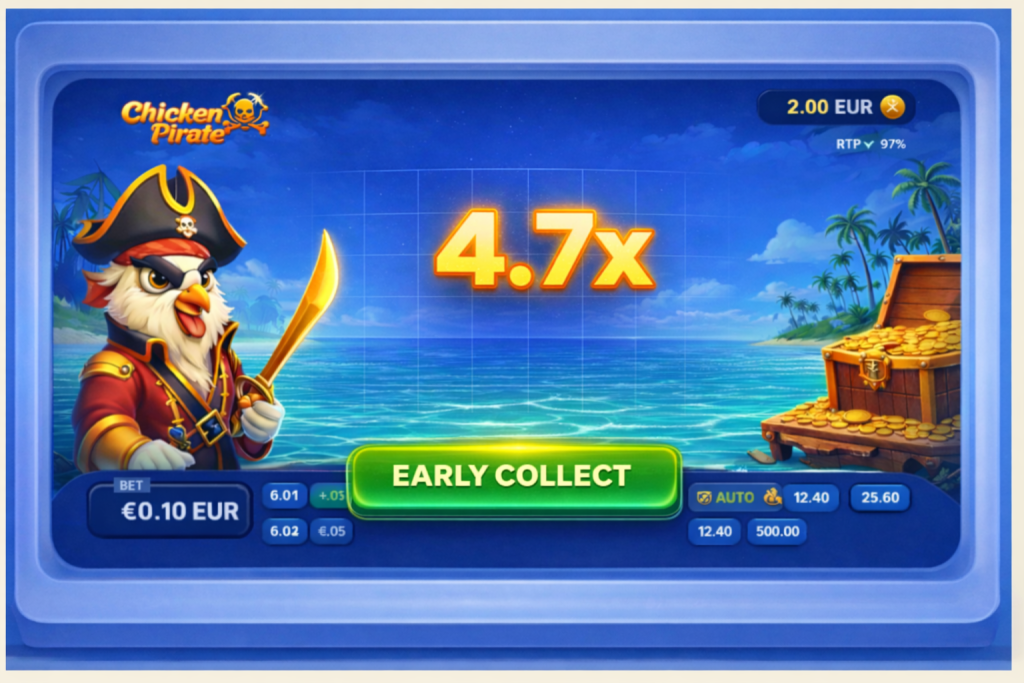
Chicken Pirate does not follow the structure that most players associate with slot games. There are no reels, no paylines, and no recognisable bonus triggers such as free spins or feature rounds. Instead, the entire experience is built around a single evolving element: a multiplier that increases over time until the round ends abruptly.
At the beginning of each round, the multiplier starts low and begins to rise. The player is given one core decision: whether to collect the current value or continue waiting as the multiplier climbs. At any moment, the round can end, and if that happens before the player collects, the entire opportunity is lost. This creates a system where timing becomes the central mechanic, replacing the structured reward systems found in traditional slots.
This is where the idea of bonuses begins to form, even though no formal bonus system exists. As the multiplier increases, the experience starts to resemble what players would normally interpret as entering a more valuable phase of the game. The longer the round continues, the more it feels as if something has been “unlocked”, even though nothing has changed except time and exposure.
For players coming from slot-based environments, this creates an immediate cognitive translation. A rising multiplier feels like progression. Progression feels like a build-up. And a build-up often leads to what players are used to calling a bonus. The mind begins to categorise the experience in familiar terms, even when those terms do not apply.
The absence of traditional features does not prevent the perception of them. Instead, the game replaces defined bonus structures with a continuous escalation that mimics their emotional effect. There is no transition into a separate mode, no animation that signals a feature, and no explicit reward phase. Yet the feeling that something valuable is approaching becomes stronger with every second the multiplier rises.
This is the foundation of how bonuses appear to exist in Chicken Pirate. They are not programmed as distinct events. They emerge from the way the system is experienced over time. The longer a player remains in a round, the more the situation begins to resemble a moment of reward, even though it is also the point at which risk is highest.
The result is a subtle but powerful shift. Instead of receiving bonuses as defined features, players begin to interpret certain moments within the round as if they were bonuses. These moments are not triggered by the game in the traditional sense. They are created by the interaction between rising values, delayed decisions, and the expectation that something better is just ahead.
When a Bonus Feels Real — But Doesn’t Actually Exist
In a traditional slot environment, a bonus is clearly defined. It is a separate feature that activates under specific conditions. Free spins, bonus rounds, and special modes are all designed to interrupt the base game and provide a distinct phase where rewards are structured differently. The player knows when a bonus begins, how it works, and when it ends.
Chicken Pirate removes this entire layer. There is no separate phase, no trigger condition that leads to a different mode, and no structural distinction between regular play and so-called bonus moments. Every round operates under the same rules from start to finish. The only variable that changes is the multiplier, and that change is continuous rather than event-based.
Despite this, the feeling of entering a bonus still appears. This happens because the human mind relies on pattern recognition and previous experience. When a player sees a value increasing over time, especially in a context where waiting can lead to a higher return, it resembles the build-up phase that often precedes a bonus in slot games. The longer the multiplier continues to rise, the more it feels like the game is approaching a reward state.
This perception becomes particularly strong when the multiplier reaches levels that are noticeably higher than the starting point. At that stage, the round no longer feels ordinary. It begins to feel significant. The player may interpret this as having “reached” something, even though there has been no transition in the system itself.
What makes this effect powerful is that it does not rely on any explicit signals from the game. There are no flashing indicators or feature announcements. The perception of a bonus is created internally by the player, based on expectation rather than structure. The game provides the conditions, but the interpretation is entirely psychological.
This leads to a situation where the most intense moments of the round are not defined by the game as rewards, but experienced by the player as if they were. A high multiplier feels like a bonus not because it is programmed as one, but because it represents a rare and valuable state within the flow of the round. The player begins to treat that moment with the same importance they would assign to a bonus feature in a slot.
However, this is where the key misunderstanding lies. In a slot, reaching a bonus typically shifts the balance of the game in favour of the player, even if only temporarily. In Chicken Pirate, reaching a higher multiplier does not change the underlying system. The probability of the round ending remains constant in principle. The only thing that has changed is how much is at stake.
As a result, the moment that feels like a reward is also the moment of greatest exposure. The longer the player waits, the more they stand to gain, but also the more they stand to lose. The perception of a bonus masks this trade-off by framing the situation as an opportunity rather than a risk.
This is why the concept of bonuses in Chicken Pirate cannot be understood in the same way as in traditional games. There are no actual bonus features to trigger or optimise. What exists instead is a series of moments that resemble bonuses from the player’s perspective, but function entirely differently within the system.
The game does not offer bonuses as separate rewards. It creates conditions where the idea of a bonus becomes convincing, even in the absence of any real feature. This distinction is subtle, but it defines how the entire experience is perceived and how decisions are made within each round.
Breaking the System: What the Game Actually Calls a Bonus
Where Slot Rewards End and Multiplier Pressure Begins
Traditional slot bonuses are built as separate events with their own entry point and reward structure. Chicken Pirate works differently. What may feel like a bonus is simply the same round continuing under rising multiplier pressure, with no trigger, no mode change and no protected reward phase.
| Slot Bonus | Chicken Pirate “Bonus” |
|---|---|
| Triggered feature | No trigger |
| Separate mode | Same round |
| Free spins / bonus round | Multiplier growth |
| Lower risk perception | Increasing risk |
| Defined reward phase | Continuous exposure |
In many descriptions of Chicken Pirate, the term “bonus” is still used, even though the structure of the game does not support traditional bonus mechanics. This creates confusion at the level of interpretation. What is presented as a bonus is not a separate feature, but a moment within the same continuous system.
Some versions of the game refer to elements such as safe steps or so-called bonus hits. These moments may appear to provide an advantage. A step may feel protected, or a sequence may continue longer than expected. From the outside, this resembles a reward condition. It suggests that the game has temporarily shifted in favour of the player.
However, nothing structural has changed. The round has not entered a new mode. There is no separate set of rules governing what happens next. The multiplier continues to rise, and the possibility of the round ending remains present at every point. The system remains consistent from the beginning of the round to its end.
The idea of a “bonus” in this context is therefore not a feature, but a label applied to a certain type of moment. It is a way of describing an experience that feels different, even though it is governed by the same mechanics. This distinction is essential, because it defines how the player interprets what is happening.
In a slot, a bonus is triggered. It has a clear entry point, a defined structure, and a measurable outcome. In Chicken Pirate, nothing is triggered. The round unfolds continuously, and any moment that feels special is simply a point along that timeline. The perception of a bonus is created by the contrast between ordinary progression and an unusually extended sequence.
This is why so-called bonus moments are often associated with longer rounds. When the multiplier continues to rise beyond what feels typical, the player begins to treat that extension as something earned or activated. In reality, it is simply variance within the system. The round has not become safer or more predictable. It has only lasted longer.
The use of the term “bonus” introduces a narrative that does not match the underlying structure. It suggests that the player has entered a different state of the game, when in fact they are still within the same risk environment. This mismatch between language and mechanics is where misunderstanding begins.
Once a player believes they are in a bonus-like situation, their behaviour often changes. They become more willing to wait, expecting that the favourable condition will continue. This expectation is based on how bonuses function in other games, where extended value is typically supported by a defined feature. In Chicken Pirate, that support does not exist.
The result is a subtle shift in decision-making. The player is no longer evaluating the situation based on current exposure, but on the assumption that they are in a privileged phase of the round. This assumption has no basis in the system itself. It is a projection derived from previous gaming experiences.
Understanding what the game actually offers instead of traditional bonuses requires removing that projection. There is no hidden layer, no special condition, and no activated advantage. There is only a continuous process in which the multiplier increases and the risk remains present at every step.
What appears to be a bonus is simply a moment where the outcome has not yet occurred. The longer that moment lasts, the more it resembles something meaningful. But its meaning is not defined by the system. It is defined by how the player chooses to interpret it.
When a Bonus Is Just the Round Continuing — Not a Separate Feature
The most important structural difference in Chicken Pirate is that nothing interrupts the round. In slot games, bonuses exist as interruptions. They break the flow of the base game and introduce a new layer of interaction. This separation is what gives bonuses their identity. They are clearly distinguishable from regular play.
In Chicken Pirate, there is no such interruption. The round begins, the multiplier rises, and the player decides when to exit. There is no transition into a different state. Every moment belongs to the same uninterrupted sequence. This continuity changes how value is created and how it should be understood.
When players describe a moment as a bonus, they are often referring to a point where the multiplier has reached a level that feels significant. This could be a point where the potential return is noticeably higher than usual. It may feel like a reward phase, but structurally it is identical to the earlier stages of the round.
Nothing has been activated. The system has not shifted. The probability of the round ending has not been reduced. The only difference is that more time has passed, and the potential outcome has grown accordingly. This growth creates the illusion of progression, but it does not introduce any new mechanics.
The concept of a bonus normally implies that the player has gained access to something additional. In this case, nothing additional has been added. The player has simply remained in the round longer. The value they are observing is a function of time, not a result of a triggered feature.
This distinction becomes critical when decisions are made. If a player believes they are in a bonus phase, they may assume that the current state is more favourable than it actually is. This can lead to delayed exits and increased exposure. The decision is no longer based on risk management, but on the expectation that the situation will continue to improve.
In reality, the system does not reward waiting in a structured way. It allows for the possibility of higher outcomes, but it does not guarantee them or support them through a defined feature. Every additional moment carries the same uncertainty as the previous one. The round can end at any time, regardless of how far it has progressed.
This means that what feels like a bonus is simply the absence of an outcome so far. The player is experiencing a prolonged sequence, and that sequence is being interpreted as something meaningful. The meaning is not built into the system. It is constructed by the player based on familiarity with other game types.
By removing the idea of a separate feature, the game places all value within a single continuous process. There are no layers to switch between, no modes to enter, and no phases to complete. Everything happens within one timeline, and every decision is made within the same set of conditions.
Understanding this changes how the entire experience is approached. Instead of looking for moments where the game becomes more generous, the player begins to recognise that every moment carries the same fundamental uncertainty. The multiplier may increase, but the structure does not.
What appears to be a bonus is therefore not a reward mechanism, but a point of interpretation. It is where the player chooses to see value as something special, rather than as part of an ongoing process. Recognising this difference is essential for understanding how Chicken Pirate actually functions and why it feels the way it does.
The Risk Curve: Where Bonus Feeling Meets Maximum Exposure
When the Multiplier Looks Better, the Position Becomes More Fragile
This graph shows the real tension inside a Chicken Pirate round. As time moves forward, the multiplier rises and the moment begins to feel more valuable. At the same time, exposure increases with it. What seems like a bonus is not a reward phase, but the point where the player is already carrying more risk.
What players describe as a “bonus moment” in Chicken Pirate tends to occur at a very specific point in the round. It is not random in perception. It appears when the multiplier has risen enough to feel meaningful, but not yet high enough to feel unattainable. This creates a narrow window where anticipation and perceived value intersect.
At this stage, the round no longer feels neutral. It feels charged. The multiplier has moved beyond its early phase, and the player is no longer simply observing growth. They are now evaluating a decision that carries weight. The higher value creates the impression that something significant is happening, even though the underlying system remains unchanged.
This is where the concept of a bonus becomes most convincing. The player experiences a sense of progression that resembles the build-up to a reward. The round has lasted longer than expected, the multiplier has reached a level that feels worthwhile, and the situation appears to be improving. All of these elements combine to create the impression that the game is offering something extra.
In reality, this moment represents the highest level of exposure within the round so far. The player has committed time, attention, and potential value. The longer they remain in the round, the more they risk losing if the outcome occurs before they collect. The perceived reward is directly tied to the level of risk, not separate from it.
This relationship is not always obvious during play. The increase in multiplier is visible and easy to understand. The increase in exposure is less visible, because it is not displayed as a separate metric. It exists as a consequence of staying in the round longer, rather than as an explicit value on the screen.
As a result, the player may interpret the situation as increasingly favourable, when in fact it is becoming increasingly fragile. The longer the round continues, the more it feels like a bonus, but also the closer it is to ending. The perception of safety grows alongside the actual level of risk.
This creates a tension that defines the entire experience. The player is drawn toward higher multipliers because they represent larger outcomes. At the same time, each additional moment increases the chance that the opportunity will disappear entirely. The system does not separate reward from risk. It combines them into a single continuous curve.
Understanding this curve is essential. The multiplier does not simply represent potential gain. It also represents accumulated exposure. Each increment reflects not only a higher possible return, but also a longer period of vulnerability. The two are inseparable.
What feels like a bonus is therefore not a safe or protected state. It is the point at which the balance between potential reward and potential loss becomes most extreme. The player is closest to achieving a high outcome, but also closest to losing everything that has been built up in that round.
This is why the most attractive moments in the game are also the most dangerous. They are defined by their intensity, not by any structural advantage. The system has not shifted in favour of the player. It has simply reached a point where the stakes are highest.
The Hidden Trade-Off: Every Bonus Feeling Comes With Increased Exposure
Every decision in Chicken Pirate is shaped by a trade-off between securing a known value and pursuing a higher one. This trade-off becomes more pronounced as the multiplier increases. Early in the round, the decision to collect or continue carries relatively little weight. The potential gain is small, and the potential loss is limited.
As the multiplier rises, this balance changes. The potential gain becomes more attractive, but the potential loss becomes more significant. The player is no longer deciding between small outcomes. They are deciding whether to protect a meaningful value or risk it in pursuit of something greater.
This is the point where the feeling of a bonus becomes most influential. The player may begin to see the current state as an opportunity that should be maximised. The idea of leaving the round too early can feel like missing out on something important. The expectation that the multiplier might continue to rise reinforces the decision to wait.
However, this expectation is not supported by any change in the system. The probability of the round ending does not decrease as the multiplier increases. Each additional moment carries the same fundamental uncertainty. The system does not provide a safety net for higher values. It only allows them to exist temporarily.
The longer the player waits, the more they are exposed to the possibility of losing everything from that round. This exposure is cumulative. It grows with each second, even though it is not directly displayed. The player sees the multiplier increasing, but may not fully account for how much has already been placed at risk.
This creates a situation where the perception of a bonus encourages behaviour that increases vulnerability. The player is drawn toward higher values because they appear more rewarding. At the same time, those values exist in a state that can disappear instantly. The trade-off is not between low and high reward alone. It is between certainty and uncertainty.
In traditional bonus features, the player is often given a defined structure that supports higher outcomes. There may be additional spins, modified rules, or guaranteed sequences that extend the opportunity. In Chicken Pirate, none of these elements are present. The system does not change to accommodate higher values. It remains constant.
This means that the responsibility for managing the trade-off lies entirely with the player. There is no feature that protects them once a certain level is reached. There is no phase where the game becomes more predictable or more controlled. Every decision must be made within the same conditions that existed at the start of the round.
The feeling of a bonus can obscure this reality. It frames the situation as a moment to push further, rather than a moment to evaluate risk. The player may focus on what could be gained, rather than on what is currently at stake. This shift in focus is subtle, but it has a direct impact on outcomes.
Recognising the trade-off does not eliminate the appeal of higher multipliers. It clarifies what they represent. They are not rewards that have been granted by the system. They are opportunities that exist within a continuously uncertain environment. The value they offer is inseparable from the risk they carry.
In this sense, every bonus-like moment is a point of decision, not a point of advantage. The player is not being given something extra. They are being asked to choose how much they are willing to risk in order to pursue what comes next.
Player Behaviour: Why the Search for Bonuses Never Ends
How the Cycle of Waiting and Losing Repeats Itself
The idea of a bonus does not come from the structure of Chicken Pirate. It comes from the player. More specifically, it comes from habits formed in other types of games, where bonuses are clearly defined, triggered, and expected as part of the experience.
When players enter Chicken Pirate, they do not leave those expectations behind. They bring with them a mental model shaped by slot mechanics. In that model, progress leads to a feature, and features lead to rewards. Even when the game does not support this structure, the expectation remains active.
This is why players continue to look for bonuses, even when none exist. The rising multiplier resembles progression. Progression suggests that something will happen next. That “something” is often interpreted as a bonus, because that is how similar patterns are resolved in other games.
As rounds unfold, this expectation begins to influence behaviour. When the multiplier increases beyond its early stage, the player may start to feel that they are approaching a meaningful moment. The decision to collect becomes more difficult, because leaving the round feels like exiting too early, before the expected reward has appeared.
This creates a cycle. The player waits longer, the multiplier increases, and the perceived importance of the moment grows. If the round ends before the player collects, the outcome is not only a loss of value, but also a disruption of expectation. It feels as though something was about to happen, but did not.
This feeling is particularly strong in situations where the multiplier reaches a level that seems close to a personal target. The player may think in terms of thresholds, such as reaching a certain number before collecting. When the round ends just before that point, the experience is interpreted as “almost getting the bonus”.
This interpretation has a direct impact on future behaviour. The player is more likely to continue playing, not because of a structural advantage, but because of an unresolved expectation. The idea that the bonus is still “due” or “within reach” encourages continued engagement.
However, this expectation is not grounded in the system. Each round is independent. There is no accumulation of progress, no hidden counter, and no delayed feature waiting to be triggered. The sense of being close to a bonus is entirely subjective. It does not reflect any underlying state of the game.
Despite this, the cycle persists. The combination of rising multipliers, near-threshold outcomes, and the absence of a clear reward phase creates a feedback loop. The player continues to search for a moment that feels complete, even though the system does not provide one.
This is why the search for bonuses in Chicken Pirate does not end. It is not sustained by the mechanics of the game, but by the way the game is interpreted. As long as the experience resembles progression, the expectation of a reward will remain.
When Higher Multipliers Replace the Idea of a Bonus Round
In the absence of traditional bonus features, higher multipliers begin to take on their role. They become the moments that players aim for, the points that feel significant, and the outcomes that define a successful round.
When the multiplier reaches a higher level, the experience changes in perception. The round no longer feels ordinary. It feels as though something important has been achieved. This mirrors the way players experience bonus rounds in slot games, where reaching a feature represents a shift into a more valuable phase.
However, in Chicken Pirate, this shift is only perceptual. The system has not entered a new state. The rules have not changed. The player is still operating within the same continuous structure that has been present since the beginning of the round.
What has changed is the scale of the outcome. A higher multiplier represents a larger potential return, and that increase in value creates a sense of significance. The player begins to treat this moment as if it were a reward phase, even though it has not been triggered by any specific condition.
This substitution is important. Instead of waiting for a bonus round to begin, players begin to aim for certain multiplier levels. These levels act as informal targets. Reaching them feels like completing a stage, even though the game does not define them as such.
The danger of this substitution is that it can obscure the nature of the system. A higher multiplier does not provide any additional protection or advantage. It does not make the round more stable or more predictable. It simply represents a higher point on the same curve of risk and reward.
When players treat these moments as bonus equivalents, they may assume that they carry the same properties as traditional features. This can lead to decisions based on expectation rather than structure. The player may wait longer, believing that they are in a favourable position, when in fact they are exposed to the same uncertainty as before.
Understanding that higher multipliers replace the idea of a bonus, rather than functioning as one, changes how these moments are approached. They are not rewards that have been granted. They are positions within a continuous process, where value and risk increase together.
Frequently Asked Questions About Bonuses in Chicken Pirate
No. The game does not include traditional bonus features such as free spins or separate bonus rounds. All activity takes place within a single continuous round.
The term is often used informally to describe moments where the multiplier reaches higher levels. These moments feel significant, but they are not separate features.
No. There are no triggers or conditions that activate a different mode of play. Each round follows the same structure from start to finish.
They are often perceived that way by players, but structurally they are not. A higher multiplier is simply a later stage of the same round.
No. Waiting longer increases both potential return and exposure, but it does not change the underlying probabilities of the round.
Because the rising multiplier creates a sense of progression, which players associate with bonus features from other games.
No. Since bonuses do not exist as features, there is no method to trigger or optimise them. Decisions are limited to when to collect.
No. There are no bonus mechanics that alter the overall return or probability. Outcomes are determined by the same system in every round.
Bonuses as a Decision, Not a Reward
Chicken Pirate does not remove bonuses by replacing them with another feature. It removes them entirely and replaces their function with something more subtle. Instead of offering a defined reward phase, the game creates moments that feel like rewards, without ever changing the structure of play.
These moments are not accidental. They emerge from the interaction between rising multipliers, delayed decisions, and the expectation that progress should lead to a reward. The longer a round continues, the more it resembles a bonus situation, even though it remains part of the same continuous system.
This creates a fundamental shift in how the game should be understood. Bonuses are no longer events that are triggered. They are perceptions that arise within the player’s experience. The system does not grant them. The player identifies them.
Recognising this changes the role of decision-making. Instead of waiting for a bonus to appear, the player is constantly evaluating whether the current state is worth securing. Every moment carries the same uncertainty, regardless of how valuable it appears.
In this sense, what feels like a bonus is actually a question. It is the point at which the player must decide whether to accept the current outcome or continue into a more uncertain future. The game does not provide an answer. It only presents the conditions under which that decision must be made.
Chicken Pirate does not reward players with bonuses. It presents them with situations that resemble rewards, while remaining governed by the same underlying mechanics. Understanding this distinction is essential, because it defines not only how the game works, but how it is experienced.