
Game Strategies in Chicken Pirate: Understanding Decisions, Risk and Player Behaviour
When Strategy Stops Meaning Control: Entering the Logic of Chicken Pirate
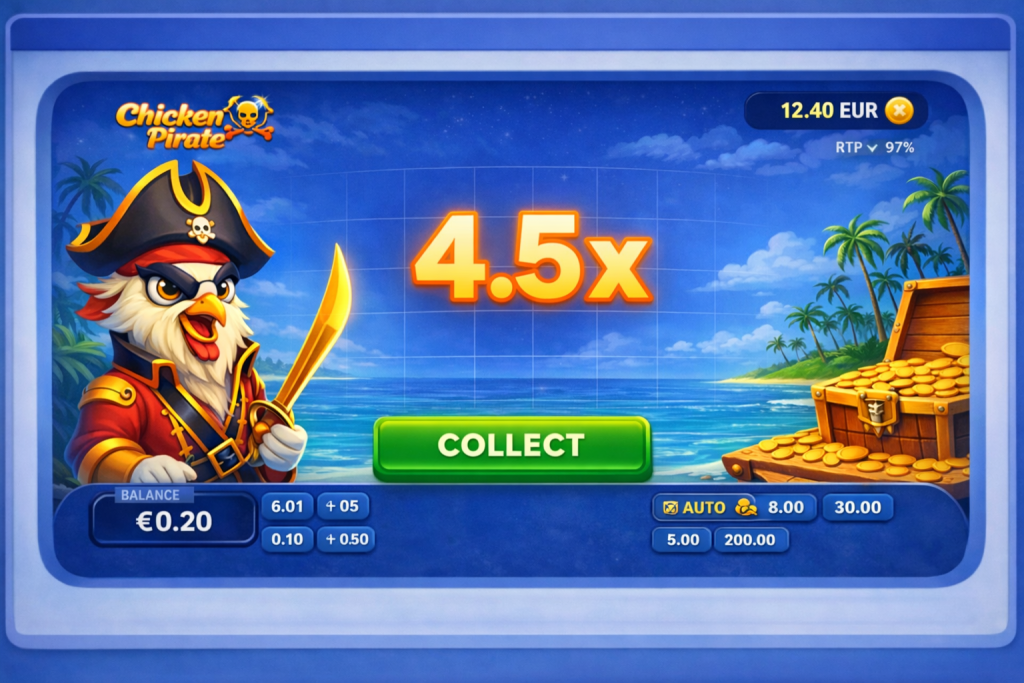
Chicken Pirate is often placed alongside online slot games, yet the way it operates immediately sets it apart. There are no reels to spin, no paylines to follow, and no symbols that combine into wins. Instead, every round is built around a single, continuously increasing value: the multiplier. It begins at a minimal level and rises in real time, creating a short window during which a decision must be made.
The structure is direct. A round starts, the multiplier grows, and at an unpredictable moment the round ends. If the player collects before that moment, the multiplier is secured. If not, the result is lost. There are no additional mechanics influencing this flow. The entire experience is reduced to timing within uncertainty.
This simplicity changes how the game is understood. In traditional slot environments, players often approach gameplay through layered systems. They consider features, bonus triggers, symbol behaviour, and stake adjustments. Strategy, in that context, is associated with navigating complexity. Chicken Pirate removes that complexity and replaces it with a single repeating decision.
At first glance, this might suggest that strategy becomes easier to define. With fewer elements, it appears that a clear approach could be developed. However, the absence of structural depth does not create clarity. Instead, it concentrates all uncertainty into one moment: when to exit.
Each round exists independently. The multiplier does not carry information from previous results, and it does not adjust based on player behaviour. A high multiplier in one round has no influence on what follows. Likewise, a series of low results does not indicate that a higher outcome is approaching. Despite this, the human tendency to search for patterns often leads players to believe that such connections exist.
The interface reinforces this perception. The collect button is always visible, always responsive, and always under the player’s control. It creates the impression that the player is actively shaping the result. In reality, the outcome has already been determined before the round begins. The only variable is whether the player exits before the crash point is reached.
This distinction is central. The player is not influencing the system, but interacting with it. Strategy, in this environment, does not function as a tool for control. It becomes a way of managing exposure to an outcome that cannot be changed.
Over time, this dynamic becomes more apparent. Collecting early produces smaller, more consistent outcomes. Waiting longer introduces higher potential values, but also increases the likelihood of losing the round entirely. The balance between these options cannot be calculated in advance. It is experienced through repetition rather than predicted through analysis.
Because of this, the idea of strategy must be reframed. It is not about finding a method that consistently produces favourable results. It is about understanding how decisions are made when results are beyond influence. Chicken Pirate does not reward systems in the traditional sense. It highlights behaviour under pressure, where each choice reflects a response to risk rather than a solution to a problem.
Why “Game Strategies” in Chicken Pirate Do Not Work the Way Players Expect
The concept of strategy is usually linked to the ability to influence outcomes. In many games, players observe patterns, adjust their actions, and refine their approach over time. This creates the expectation that a structured method can improve results. In Chicken Pirate, that expectation does not align with how the system operates.
Every round is generated independently. There is no connection between past and future outcomes, and no adjustment based on previous behaviour. Whether a round ends quickly or extends into higher multiplier ranges is not influenced by earlier results. This independence removes the foundation on which most traditional strategies are built.
In structured systems, patterns can emerge through repeated mechanics. Bonus frequencies, symbol distributions, and payout intervals provide a framework that players can study. Even when these patterns do not guarantee success, they create a sense of direction. Chicken Pirate offers no such framework. The multiplier increases continuously, but it does not follow a predictable sequence.
Despite this, players often attempt to interpret recent outcomes as meaningful. A series of low multipliers may be seen as a signal that a higher result is due. A sequence of high multipliers may create the expectation of an imminent drop. These interpretations feel logical, yet they are not supported by the system itself.
This is where the idea of strategy becomes misleading. The player’s actions do not influence the probability of future outcomes. Adjusting the timing of collection does not alter how the multiplier behaves in subsequent rounds. The system continues independently, unaffected by any decision that has been made.
What remains is a different form of engagement. Instead of analysing the system to gain an advantage, the player is interacting with a fixed structure. The only variable is the moment of exit. This transforms strategy from a method of control into a reflection of behaviour.
The collect decision creates the illusion of influence. It is immediate, visible, and directly linked to the outcome of the round. However, this influence is limited to a single moment. It does not extend beyond the current round, and it does not affect what happens next. Over time, the impact of this decision is shaped by consistency rather than optimisation.
The speed of the game further reinforces this shift. Decisions must often be made within seconds, leaving little room for extended analysis. This encourages instinctive reactions rather than calculated planning. In slower systems, players may refine their approach through observation. In Chicken Pirate, the pace limits that process.
The simplicity of the interface also plays a role. With only one primary element to focus on, the multiplier becomes central to the player’s attention. Its continuous growth creates a sense of progression, which can be mistaken for structure. Players may begin to interpret its movement as meaningful, even though it does not provide predictive information.
Over longer sessions, this perception can strengthen. Players may feel that they are improving their timing or identifying better exit points. In reality, the system remains unchanged. Variations in results are driven by randomness combined with different collection decisions, not by the development of a reliable strategy.
This does not make player decisions irrelevant. The timing of collection directly determines whether a round ends in a gain or a loss. However, this decision operates within a fixed environment where probabilities cannot be influenced. It can be managed, but not controlled.
Understanding this distinction is essential. Strategy in Chicken Pirate is not a tool for predicting outcomes or shaping results. It is a way of approaching repeated decisions in an environment defined by uncertainty. Its effectiveness is not measured by its ability to change the system, but by how consistently it is applied.
In this sense, the game shifts the focus entirely. What appears to be a strategic challenge is, in reality, a behavioural one. The player is not solving the system. The player is responding to it, round after round, within the same unchanging structure.
The Only Real Decision in the Game: When to Collect and Why It Defines Every Outcome
How One Round Unfolds Before the Outcome Is Fixed
Each round in Chicken Pirate follows the same compressed sequence. A stake enters the round, the multiplier begins to climb, and the player faces a single choice: secure the current value or remain exposed to the crash point.
What this shows: Chicken Pirate is built around a repeating decision loop rather than traditional slot mechanics. The centre of the round is not symbol matching or bonus activation, but the exact moment when the player chooses whether to collect before the crash arrives.
Once the structure of Chicken Pirate is understood, the entire idea of strategy reduces to a single repeating moment. There are no layers to manage, no features to trigger, and no combinations to anticipate. Every round leads to the same question: when to collect.
The multiplier begins to rise immediately. At first, the increase feels slow and stable. This early phase creates a sense of comfort. Collecting here feels safe, but it also limits the outcome. The result is secured quickly, yet remains relatively small.
As the multiplier grows, the situation changes. The value becomes more meaningful, and hesitation appears. Collecting now seems reasonable, but waiting slightly longer feels tempting. The decision shifts from simple safety to a balance between securing a visible result and risking it for something greater.
At higher multipliers, the pressure increases. The potential outcome becomes significant, but the round can end at any moment. Collecting secures a strong result, while waiting introduces the possibility of losing everything. This creates a tension where expectation and risk exist at the same time.
These phases are not formal mechanics. The game does not change. What changes is the perception of risk as the multiplier rises. The decision becomes more difficult not because of added complexity, but because more is at stake.
This is why the collect moment defines the entire experience. It is the point where uncertainty is resolved. Before collecting, the outcome is open. After collecting, it becomes fixed. Every round is built around this transition.
Different players approach this moment differently. Some collect early, focusing on consistency. Others wait longer, accepting higher risk for larger potential outcomes. These are not strategies that influence the system. They are behavioural patterns that define how exposure is managed.
Over time, players may feel they are improving their timing. A successful collection can reinforce certain decisions, while a loss may push behaviour in the opposite direction. These adjustments feel like optimisation, but they are reactions rather than true improvements.
The speed of the game reinforces this effect. Decisions happen quickly, often within seconds. This limits analysis and encourages instinct. The process becomes repetitive, and repetition can create the illusion of control.
However, the system does not change. Each round remains independent. The collect decision affects only the current outcome, not future ones. This makes it fundamentally different from decision-making in traditional games.
The importance of the decision lies not in control, but in timing within uncertainty. Collecting early reduces exposure but limits results. Waiting longer increases potential but raises risk. This trade-off cannot be solved. It can only be experienced.
How Risk Expands Over Time: The Multiplier as a Pressure System Rather Than a Reward
How Pressure Builds Faster Than the Multiplier Suggests
At first the round appears manageable because the multiplier rises in a calm, readable way. As time passes, however, the pressure does not increase at the same pace as the number on screen. The further the round moves, the more quickly the decision becomes psychologically heavier.
What this shows: the multiplier should not be read as a simple reward curve. Its more important function is to act as a pressure system. In the early phase the rise feels manageable, but as the round continues the emotional weight of the decision grows much faster than the number itself appears to suggest.
The multiplier in Chicken Pirate is often seen as a reward. As it increases, it appears to offer greater potential. While this is intuitive, it does not fully reflect how the system works.
The multiplier is not only increasing value. It is increasing pressure. Every step upward represents greater exposure to risk. At lower levels, the decision feels simple. The outcome is small, and collecting early secures a modest result.
As the multiplier enters the middle range, the decision gains weight. The potential outcome becomes noticeable, and hesitation appears. Collecting now feels reasonable, but continuing introduces the possibility of something more. This creates tension.
At higher levels, the pressure becomes intense. The potential reward is significant, but the risk of losing everything feels immediate. The decision becomes urgent, not because the system has changed, but because the consequences are greater.
These stages show that the multiplier is not a simple reward curve. It is a system that amplifies decision pressure over time. The longer the round continues, the more difficult the choice becomes.
Importantly, the system does not signal when it is safer or riskier to continue. There are no thresholds that change probability in a predictable way. The perception of risk is created by the player, not by the game itself.
This is why players react differently to the same multiplier. One may see a point to collect, while another sees a reason to continue. The system does not favour either approach. It presents the same conditions every time.
Over multiple rounds, players begin to associate certain multiplier ranges with specific actions. These associations come from experience, not from changes in the system. A successful outcome may encourage risk-taking, while a loss may lead to caution.
However, these patterns do not influence future results. The multiplier continues independently, and the crash point remains unpredictable. The relationship between player and system is based on response, not control.
Viewing the multiplier as a pressure system clarifies its role. It does not guide the player towards an optimal decision. It increases the difficulty of the decision as time passes. The rising number does not provide information about what will happen next. It only increases what is at stake.
This shifts the focus entirely. The game is not about chasing higher values. It is about understanding how those values affect behaviour. Each moment of delay increases both potential and risk, without ever becoming predictable.
In this environment, strategy cannot be built on prediction. It exists only as a way of interacting with pressure. The player is not solving a system. The player is responding to it, round after round, under the same conditions.
The Illusion of Patterns: Why Previous Rounds Do Not Predict the Next One
As players spend more time in Chicken Pirate, results begin to feel connected. A sequence of low multipliers may appear as a trend, while several higher outcomes can create the impression of momentum. This is where the idea of patterns begins to form.
The system itself does not support this. Each round is independent. The multiplier does not follow a cycle, and it does not react to previous outcomes. A low result does not increase the chance of a higher one, and a high result does not make a drop more likely. Every round starts under the same conditions.
Despite this, the mind naturally searches for structure. When similar outcomes appear in sequence, they are often interpreted as meaningful. It feels logical to assume that a pattern is forming, even when no such pattern exists.
This perception is reinforced by recent memory. Players often focus on the last few rounds and use them to guide decisions. A series of low multipliers may feel like a signal that something higher is due. A sequence of high multipliers may suggest that a crash is approaching. These conclusions feel convincing, but they are not supported by the system.
What is being experienced is not a pattern within the game, but a pattern within perception. The mind connects independent events to create meaning. This creates a sense of predictability where none exists.
The speed of the game intensifies this effect. Rounds follow one another quickly, allowing short sequences to form in memory. Because decisions must be made fast, there is little time to question these interpretations. The perceived pattern becomes part of the decision almost instantly.
Over time, this can influence behaviour. A player may collect earlier after several low outcomes, expecting another quick crash. Alternatively, they may wait longer, believing a higher multiplier is approaching. In both cases, the decision is shaped by past results rather than the current situation.
However, this does not provide an advantage. Since each round is independent, using previous outcomes to guide decisions does not improve results. It only changes how the same uncertainty is approached.
Understanding this removes a key misconception. Strategy cannot be built on past rounds because they do not influence the future. Each round resets completely, and the multiplier carries no information forward.
The “Almost Win” Effect: Why Players Stay Longer Than They Planned
How Near Misses Create a Continuous Behaviour Loop
In Chicken Pirate, the end of a round is not where the experience actually finishes. When a player comes close to a higher multiplier, the result carries forward. What feels like a single moment becomes part of a repeating behavioural cycle.
What this shows: the game does not operate as isolated rounds in the player’s perception. Each near result feeds into the next decision, forming a loop where emotion directly influences risk-taking behaviour.
One of the most influential behavioural effects in Chicken Pirate occurs when a player comes close to a higher multiplier but does not secure it. The difference may be small, yet the impact is significant.
A player may collect at a moderate level and then see the multiplier continue slightly higher. Or they may wait longer and miss the moment just before the crash. In both cases, the result creates the feeling of having been close to something better.
This experience is often interpreted as an almost win. Even if the outcome was not successful, it feels meaningful. The proximity to a higher value creates the impression that it could have been achieved with slightly different timing.
This perception affects behaviour. After an almost win, players often adjust their decisions. They may wait longer, believing the higher multiplier is within reach. They may also feel more confident, assuming their timing was nearly correct.
The system, however, does not recognise this proximity. Being close to a higher value does not increase the chance of reaching it in the next round. Each outcome remains independent.
What carries forward is not probability, but emotional impact. The feeling of being close creates a sense of unfinished action. This often leads to continuation, as the next round feels like an opportunity to complete what was missed.
When repeated, this effect becomes stronger. Several near outcomes can create the impression that success is approaching. This may lead to longer waiting times and increased exposure to risk. The behaviour changes, even though the system does not.
Importantly, this effect also appears after successful rounds. A player may collect at a good multiplier but still feel they exited too early if the value continues to rise. The result is positive, yet it feels incomplete.
This creates a cycle. The player attempts to correct the previous outcome, aiming to capture what was missed. Each round becomes part of that attempt, rather than an independent event.
Understanding the almost win effect explains why players often stay longer than planned. The decision is no longer based only on the current multiplier. It is influenced by recent experiences that feel relevant, even though they are not connected to future outcomes.
Recognising this changes the perspective. An almost win is not a signal or a pattern. It is a psychological response to proximity. The system itself remains unchanged.
This returns the focus to the core idea. Strategy in Chicken Pirate is not about predicting what comes next. It is about making decisions in the present, without being shaped by what has already happened.
Discipline vs Impulse: The Real Difference Between Players Over Time
How Behaviour Shapes the Experience Over Time
| Behaviour | Decision Pattern | Session Feel |
|---|---|---|
| Impulsive | constantly changes | unstable |
| Consistent | fixed timing | structured |
What this shows: the difference between players is not based on a winning system, but on behaviour. The way decisions are repeated over time defines how the session feels.
As the structure of Chicken Pirate becomes clear, one element remains consistent across every session. The system does not change, the multiplier behaves independently, and outcomes cannot be influenced. What does change is the way players respond to this environment over time.
This is where the distinction between discipline and impulse becomes important. It is not a difference in strategy as a system, but a difference in behaviour. Since no method can alter probabilities, the only variation comes from how decisions are made and repeated.
Impulse-driven play is shaped by recent outcomes and immediate reactions. A player may wait longer after an almost win, expecting a higher multiplier to appear again. They may collect earlier after a loss, attempting to avoid another negative result. Each decision is influenced by what has just happened, rather than by a consistent approach.
This creates variability. The timing of collection shifts from round to round, often without a clear structure. The player reacts to the moment, adjusting continuously. While this can feel adaptive, it is not based on any change within the system. It is a response to perception rather than to probability.
Discipline, in contrast, is defined by consistency. It does not mean predicting outcomes or controlling the game. It means applying the same approach regardless of recent results. The player defines a way of interacting with the multiplier and maintains it over time.
This consistency does not create an advantage in the traditional sense. It does not increase the likelihood of favourable outcomes. What it does is stabilise behaviour. Decisions are no longer shaped by short-term variation, but by a fixed approach to risk.
The difference between these two behaviours becomes more visible over longer sessions. Impulse leads to fluctuation, with decisions constantly changing in response to previous rounds. Discipline creates a more stable pattern, where the same type of decision is repeated regardless of outcome.
Neither approach changes the system. The multiplier continues to rise, and the crash point remains unpredictable. However, the experience of the session can feel very different. One is reactive and variable, the other structured and consistent.
It is important to understand that discipline is not a method for winning. It does not reduce uncertainty or eliminate risk. It simply defines how a player engages with the same conditions over time. The system remains unaffected.
In this context, strategy becomes a matter of behaviour rather than calculation. The player is not solving a problem, but choosing how to respond to repeated uncertainty. Over time, this response becomes the defining element of the session.
Questions Players Often Ask About Chicken Pirate Strategies
This Is Not a System to Solve, but a System to Respond To
Chicken Pirate presents itself as a simple structure, yet that simplicity hides its true nature. There are no layers to analyse, no mechanics to optimise, and no patterns to decode. The multiplier rises, the crash occurs, and the sequence repeats. The system remains unchanged from one round to the next.
What changes is the player. Each decision reflects a response to uncertainty, shaped by perception, experience, and behaviour. The idea of strategy, in its traditional sense, does not apply here. There is no method that can control outcomes or predict results with consistency.
Instead, the game reveals how decisions are made under pressure. The moment of collection becomes the centre of the experience, not because it influences the system, but because it defines the interaction with it. Every round presents the same conditions, yet each decision can feel different.
Over time, this creates a shift in understanding. The focus moves away from trying to find a winning approach and towards recognising the nature of the system itself. Chicken Pirate does not reward strategic systems. It exposes behavioural patterns.
In this sense, the game is not something to be solved. It is something to be experienced. The player is not controlling the outcome, but responding to it. And within that response lies the only form of strategy the game allows.