Glossary Chicken Pirate — Understanding the Language Behind Every Decision
A Game That Speaks in Decisions, Not Symbols
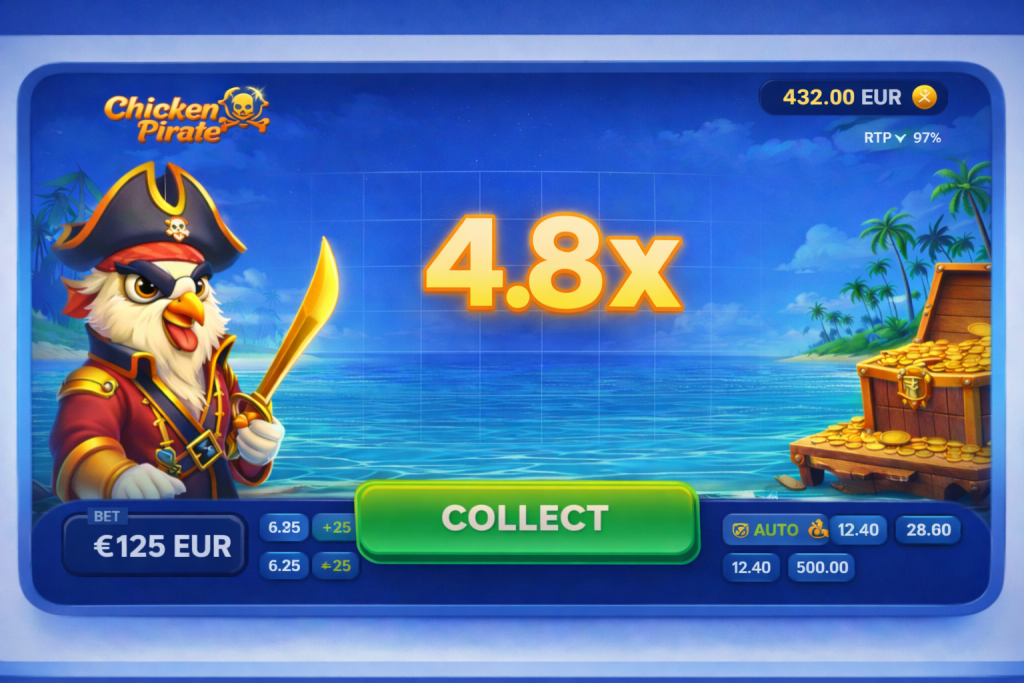
Chicken Pirate does not introduce itself through familiar slot mechanics. There are no reels to spin, no paylines to follow, and no symbols to interpret. Instead, the game presents a single, continuously rising multiplier and a single decision that defines every round: when to collect. For many players, this shift is not immediately obvious. They approach the game with expectations shaped by traditional slots, only to realise that none of the usual reference points apply.
The absence of classic structures creates a different kind of experience. There is no sequence of spins building towards a bonus feature, no anticipation of scatter combinations, and no fixed rhythm defined by reels. What replaces this is a live, unfolding curve where risk increases with every passing moment. The multiplier does not wait. It moves, and the player must respond.
At first glance, the interface appears simple. A number increases, a button offers the option to collect, and a crash may occur at any time. Yet beneath this simplicity lies a completely different language. The terms that matter here are not inherited from slots. They emerge from the structure of the game itself. Multiplier, crash, and collect are not just features; they are the foundation of how the game is understood.
This is why a glossary for Chicken Pirate cannot be approached as a list of definitions. It is not about translating individual words, but about understanding how those words form a system. Each term gains meaning through its relationship with the others, and through the decisions the player makes in response to them. Without that context, the vocabulary remains superficial.
The purpose of this glossary is therefore not to explain the game in isolation, but to clarify how it operates through its language. It offers a way to interpret what is happening on the screen, and more importantly, to recognise what each moment represents. In a game where outcomes cannot be predicted and timing cannot be controlled, understanding the language becomes the only stable point of reference.
When Slot Language Stops Making Sense — A Different Vocabulary Begins
Players entering Chicken Pirate often carry a set of assumptions shaped by traditional slot games. These assumptions are built around structure. A slot presents reels, each reel contains symbols, and those symbols align across paylines to produce outcomes. Even when volatility varies, the underlying logic remains consistent. The player interacts with a system that is both visible and repeatable.
None of this applies here.
There are no reels to define position, no paylines to determine combinations, and no symbols to interpret. Without these elements, the usual terminology loses its function. Words like scatter, wild, or bonus round are not simply absent; they are irrelevant. They describe a system that does not exist in this context.
What replaces that system is not a variation of slot mechanics, but an entirely different structure. At the centre of this structure is the multiplier. It begins at a base value and increases continuously over time. Unlike reels, which resolve outcomes at a fixed moment, the multiplier evolves in real time. It does not wait for a spin to finish. It creates a moving environment where the state of the game is constantly changing.
Alongside the multiplier, two other terms define the experience: crash and collect.
The crash represents the endpoint of a round. It is not triggered by visible conditions, nor can it be anticipated through patterns. It occurs at an unknown moment, immediately ending the round and removing any uncollected value. This introduces a fundamental uncertainty that cannot be managed through observation alone.
The collect action is the only decision available to the player. It allows the current multiplier to be secured before a crash occurs. There are no secondary choices, no adjustments, and no layered features. The entire interaction is reduced to a single question repeated in every round: whether to continue or to exit.
This simplicity is often misunderstood. It may appear that fewer elements make the game easier to read. In reality, the absence of structure removes familiar anchors. In a slot, the player can observe patterns of symbols, track bonus frequency, or at least perceive a sequence of outcomes. In Chicken Pirate, there is no sequence in the same sense. Each round begins independently, and the multiplier’s path offers no indication of where it will end.
As a result, the language of the game becomes critical. Without reels or symbols to guide interpretation, the player relies on terms that describe behaviour rather than structure. Multiplier is not just a number; it represents the growth of risk. Crash is not just an event; it defines the boundary of possibility. Collect is not simply a button; it is the moment where uncertainty is converted into a result.
Understanding these terms requires a shift in perspective. Instead of analysing static elements, the player must interpret a dynamic process. The focus moves from what is displayed to how it evolves. Each second carries a different level of exposure, and each decision carries a different implication.
This is where the traditional slot vocabulary becomes misleading. It suggests that outcomes are tied to visible configurations, when in fact they are determined independently of any visual pattern. Attempting to apply slot logic in this environment leads to confusion, because it assumes a level of control that is not present.
A different vocabulary is therefore not optional; it is necessary. It allows the player to align their understanding with the actual structure of the game. Without it, the experience remains fragmented, interpreted through concepts that do not apply.
In Chicken Pirate, language does not describe the game after the fact. It shapes how the game is experienced in real time. Recognising this shift is the first step towards understanding what the game truly represents: not a sequence of outcomes, but a continuous negotiation between increasing value and uncertain limits.
The Three Terms That Quietly Control Every Round
From Stake to Result
The round follows a single, continuous path built around growth and one decision. There are no extra mechanics, only progression and outcome.
Stake enters
The round begins as soon as the stake is placed into play.
Multiplier grows
The value increases over time, raising both reward and risk.
Decision point
The player chooses whether to collect or keep waiting.
End of round
The round finishes with a collect or a crash.
Every round in Chicken Pirate is built on a structure so minimal that it can be overlooked. There are no layers of mechanics, no hidden features, and no expanding systems. Instead, the entire experience is defined by three terms that operate together with complete precision: multiplier, crash, and collect. These are not separate elements that can be analysed in isolation. They form a closed system in which each part only makes sense in relation to the others.
The multiplier is the starting point of every round. It begins at a base value and increases continuously over time. Unlike traditional games where outcomes are resolved at a fixed moment, the multiplier creates a moving state. It introduces progression without guaranteeing completion. The longer it rises, the greater the potential return, but also the greater the exposure to loss. This is not a passive number. It actively reshapes the conditions of the round with every fraction of a second.
However, the multiplier has no natural endpoint that the player can observe or anticipate. Its movement suggests continuation, but that suggestion is deceptive. The increase creates the impression of momentum, yet this momentum can be interrupted at any moment by the second defining term: the crash.
The crash is not a visible process. It does not build gradually, and it does not provide signals that can be interpreted reliably. It occurs instantly, ending the round and removing all uncollected value. The relationship between multiplier and crash is what defines the core tension of the game. As the multiplier rises, the player is presented with increasing opportunity, but that opportunity exists under the constant threat of immediate loss.
This creates a structure where growth and risk are inseparable. There is no stage of the round where the player is safe. Even at low multipliers, a crash can occur. At higher multipliers, the perceived reward increases, but so does the cost of hesitation. The system does not reward waiting in a predictable way, nor does it punish early decisions in a consistent manner. It simply maintains uncertainty at all times.
Within this structure, the only action available to the player is collect. This action converts the current multiplier into a result, ending the round on the player’s terms. It is not an enhancement or a feature; it is the single point of control within an otherwise uncontrollable system. The decision to collect is therefore not about triggering an outcome, but about defining when exposure ends.
The interaction between these three terms is continuous. The multiplier rises, creating a growing opportunity. The crash remains hidden, defining an invisible limit. The collect action interrupts this process, allowing the player to exit before that limit is reached. No other mechanics interfere with this relationship. There are no modifiers, no bonuses, and no alternative paths. Everything is contained within this loop.
Understanding this system requires recognising that the player is not influencing the multiplier or the crash. Both operate independently of any action taken. The only variable the player controls is the timing of the collect. This shifts the focus of the game away from outcome generation and towards decision timing. The result of each round is not determined by skill in the traditional sense, but by the moment at which the player chooses to stop.
This simplicity often leads to misinterpretation. Because there are only three visible elements, it can appear that the system is easy to predict or manipulate. In reality, the absence of complexity removes distractions rather than uncertainty. The player is left facing a direct relationship between increasing value and unpredictable termination.
Each round is therefore self-contained. There is no carry-over from previous rounds, no accumulation of state, and no adjustment based on past outcomes. The multiplier does not “remember” previous behaviour, and the crash does not follow sequences. This independence reinforces the role of the three core terms as a complete system. They do not evolve across rounds; they repeat with the same underlying structure every time.
What changes is the player’s interpretation. As rounds progress, the player may begin to associate certain multiplier ranges with expectations or develop preferences for when to collect. These interpretations, however, exist outside the system itself. The game continues to operate in the same way, regardless of how it is perceived.
The three terms that define Chicken Pirate are therefore not just descriptors of mechanics. They represent the entire logic of the game. Multiplier introduces growth, crash imposes a limit, and collect defines the moment of exit. Everything that happens within a round can be understood through this relationship.
This Game Is Measured in Moments, Not Mechanics
While the structure of Chicken Pirate can be described through its core terms, the experience of playing it is better understood through moments. Unlike traditional games where actions are tied to discrete events, this game unfolds as a continuous sequence. There is no clear separation between phases. Instead, the player moves through a series of psychological and temporal states that shape each decision.
The first of these is the entry moment. This occurs at the beginning of the round, when the multiplier starts to rise. At this stage, risk is minimal in absolute terms, but the decision framework is already active. The player is immediately placed in a position where action will be required, even if no action is taken yet. The round has begun, and with it, the process of evaluation.
As the multiplier increases, the player enters what can be described as the hold moment. This is the phase where the game appears stable. The multiplier continues to rise, and the absence of a crash reinforces the perception that waiting is justified. This moment is often associated with a growing sense of confidence. The longer the round continues without interruption, the more natural it feels to remain within it.
However, this perception is not based on any structural change within the game. The underlying conditions remain identical from the start of the round. The transition from entry to hold is not driven by mechanics, but by interpretation. The player begins to assign meaning to the duration of the round, even though that duration has no predictive value.
As the multiplier reaches higher values, the player encounters the panic moment. This is where the tension between opportunity and risk becomes most pronounced. The potential return is now significant, but so is the possibility of losing it entirely. The decision to collect becomes increasingly urgent, yet also increasingly difficult. Waiting promises more, but threatens everything already gained.
The panic moment is not defined by a specific multiplier value. It varies depending on the player’s tolerance for risk and perception of value. For some, it may occur early in the round. For others, it may only emerge at higher multipliers. What remains consistent is the nature of the conflict. The player is forced to choose between securing a result and continuing to expose that result to loss.
The final phase is the exit moment. This occurs either when the player chooses to collect or when the round ends through a crash. In the case of a successful collect, the player defines the endpoint. In the case of a crash, the endpoint is imposed. These two outcomes may appear similar in terms of conclusion, but they differ fundamentally in terms of control.
The exit moment is where the round is resolved, but it is also where interpretation begins. Players often evaluate their decision based on what happens immediately after. If the multiplier continues to rise after a collect, the decision may be perceived as premature. If a crash occurs shortly after, the decision may be seen as correct. However, this evaluation is retrospective and does not reflect the conditions that existed at the time of the decision.
Understanding the game through moments rather than mechanics allows for a clearer interpretation of its structure. The player is not navigating a system of features, but moving through a sequence of decisions under uncertainty. Each moment carries a different psychological weight, even though the mechanical conditions remain unchanged.
This perspective highlights an important aspect of Chicken Pirate. The game does not evolve in the way traditional games do. It does not introduce new elements or shift into different modes. Instead, it repeats the same structure while creating variation through timing and perception. The experience changes, not because the game changes, but because the player’s position within each moment changes.
By recognising these moments, the player gains a more accurate understanding of how the game is experienced. It is not defined by what is visible on the screen alone, but by how each stage influences the decision to continue or to exit. The multiplier provides the context, the crash defines the limit, and the collect determines the outcome. Between these points, the game is shaped by moments that exist entirely within the flow of time.
Risk Has Its Own Language — And Players Speak It Without Noticing
The pressure climbs with time
Early in the round, the multiplier is still modest and the player has space to observe. A few seconds later, the value increases, but the decision becomes harder as the gap between collect and crash tightens.
The line rises as time increases, showing how exposure grows together with the multiplier.
Once the core system of multiplier, crash, and collect is understood, a deeper layer of the game begins to emerge. This layer is not defined by visible mechanics, but by how players experience risk over time. Chicken Pirate does not present risk as a static value or a fixed setting. Instead, it allows risk to evolve continuously within each round. To understand this properly, a different vocabulary is required, one that reflects behaviour rather than structure.
The first and most important of these terms is exposure. Exposure describes how much of the current potential value remains at risk at any given moment. When the multiplier is low, exposure is limited. As it increases, exposure grows proportionally. The player is not simply watching a number rise; they are allowing more value to remain unprotected with each passing second. This is not always recognised consciously, but it defines the true state of the round.
Exposure is directly linked to time. The longer a player remains in the round, the more they are exposed to the possibility of a crash. This creates a dynamic where time itself becomes a variable. In traditional games, time between spins does not influence the outcome. Here, time is inseparable from risk. Every moment spent waiting increases both potential reward and potential loss.
Closely connected to exposure is the concept of risk escalation. Risk in Chicken Pirate does not remain constant. It intensifies as the multiplier rises. This escalation is not driven by changes in probability, but by changes in consequence. Losing at a low multiplier represents a small loss of opportunity. Losing at a higher multiplier represents the loss of a much larger potential gain. The system does not adjust the likelihood of a crash, but it changes what is at stake when it occurs.
Another important term is the exit point. This refers to the moment at which a player decides to collect. Unlike in traditional games, where outcomes are determined by predefined conditions, the exit point is entirely defined by the player. It represents a personal threshold, influenced by perception, tolerance, and previous experience. Two players may face the same multiplier and make completely different decisions, each based on their own interpretation of risk.
The idea of loss tolerance also plays a central role. Loss tolerance is not about how much a player can afford to lose overall, but about how much potential value they are willing to let go within a single round. Some players are comfortable risking higher multipliers in pursuit of larger returns. Others prefer to secure smaller gains more consistently. This tolerance shapes behaviour, but it does not alter the underlying system. The game remains unchanged, regardless of how it is approached.
Session depth is another term that emerges from this layer of understanding. It describes how long a player continues to engage with the game across multiple rounds. While each round is independent, the accumulation of decisions creates a broader experience. A short session may feel controlled and contained, while a longer session introduces more variation and emotional fluctuation. Session depth does not influence individual outcomes, but it affects how those outcomes are perceived over time.
What is important about this vocabulary is that it is rarely displayed on the screen. The interface shows the multiplier, the collect option, and the result of each round. It does not show exposure, escalation, or tolerance. These concepts exist in the interpretation of the player. They form an internal framework through which the game is experienced.
This internal framework often develops without conscious awareness. Players may not use the terms explicitly, but they respond to the conditions those terms describe. They feel when risk increases, even if they do not define it as escalation. They sense when too much is at stake, even if they do not describe it as exposure. The language exists implicitly, shaping decisions without being formally recognised.
Understanding this layer changes how the game is perceived. It shifts the focus away from the idea of winning or losing individual rounds and towards the management of risk within each moment. The player is not navigating a set of features, but adjusting their position within a continuous spectrum of exposure.
This is why risk in Chicken Pirate cannot be reduced to a single label such as volatility. Volatility suggests a pattern of outcomes over time. Here, the experience of risk is immediate and constantly evolving. It is not something that can be measured in advance, but something that is felt and managed in real time.
By recognising the language of risk, the player gains a clearer understanding of what is actually happening during each round. The multiplier shows growth, but exposure defines what that growth means. The crash ends the round, but escalation determines the impact of that ending. The collect secures a result, but the exit point reflects the player’s interpretation of the entire process.
Words That Don’t Exist on the Screen — But Define Every Decision
Beyond the structural terms and the language of risk, there is another layer that influences how Chicken Pirate is experienced. This layer is made up of informal, often unspoken phrases that players use internally. These are not official terms, and they do not appear in the interface. Yet they play a decisive role in shaping behaviour.
One of the most common expressions is “just one more step”. This phrase captures the moment when a player decides to continue, even when a reasonable opportunity to collect has already appeared. It reflects a belief that the multiplier will continue to rise, or at least that it is worth waiting a little longer. This belief is not based on any change in the system, but on the perception of momentum created by the rising number.
Another frequent thought is “too early”. This typically occurs after a player has collected and the multiplier continues to increase. The decision, which was made under uncertainty, is re-evaluated based on information that was not available at the time. The player interprets the outcome as evidence that they could have achieved more, even though the original conditions have not changed.
In contrast, “too greedy” is often used when a crash occurs shortly after a decision to continue. In this case, the player interprets the decision as excessive, suggesting that they should have collected earlier. Again, this judgement is retrospective. It assigns meaning to the outcome after it has already been determined, rather than reflecting the uncertainty that existed before.
Perhaps the most influential phrase is “almost had it”. This expression arises when a crash occurs at a multiplier close to where the player intended to collect. It creates a strong emotional response, as it suggests that success was within reach. However, this perception is misleading. The distance between “almost” and “achieved” is defined entirely by timing, not by proximity.
These phrases share a common characteristic. They reinterpret events after they have occurred, creating a narrative that simplifies the decision-making process. Instead of recognising that each decision was made under uncertainty, they imply that the correct choice was always clear. This can lead to a distorted understanding of the game, where outcomes are seen as predictable in hindsight.
Importantly, these expressions do not alter the mechanics of the game. The multiplier does not respond to belief, and the crash does not adjust based on previous decisions. Yet the influence of these phrases is significant. They shape how players approach future rounds, often reinforcing patterns of behaviour that feel logical but are not grounded in the structure of the system.
For example, after experiencing a “too early” outcome, a player may choose to wait longer in the next round. After a “too greedy” outcome, they may collect earlier. These adjustments create the impression of learning or adaptation, but they do not provide any real advantage. Each round remains independent, and the underlying uncertainty remains unchanged.
What these phrases reveal is not information about the game, but information about the player’s interpretation of it. They highlight the gap between what the system does and how it is perceived. This gap is where most misunderstandings arise.
Recognising these informal terms as part of the player’s internal language is an important step in understanding Chicken Pirate. It allows the player to separate the actual structure of the game from the narratives that are built around it. The game itself remains consistent, but the interpretation of its outcomes can vary widely.
By identifying these patterns of thought, it becomes possible to approach each round with a clearer perspective. Decisions are no longer judged solely by their outcomes, but by the conditions under which they were made. The multiplier continues to rise, the crash remains unpredictable, and the collect remains the only point of control. Within this framework, the language of the player can either clarify or distort the experience.
Understanding the difference between these two layers, the visible system and the internal narrative, is essential for interpreting the game accurately. Without this distinction, it is easy to confuse perception with structure, and to treat subjective impressions as objective signals.
The Most Dangerous Terms Players Bring From Slots
Where Slot Assumptions Collapse
This comparison makes the misunderstanding clear. Ideas borrowed from slots may sound useful, but they do not describe how Chicken Pirate actually behaves. The round remains independent, unpredictable and structurally simple from start to finish.
| Assumption | Reality in Chicken Pirate |
|---|---|
| There are patterns | Outcomes are independent |
| Strategy can win | No system works |
| Timing can be learned | Timing cannot control outcomes |
| Game has phases | Only random variation |
As players become more familiar with Chicken Pirate, a different type of misunderstanding begins to appear. It does not come from the game itself, but from ideas carried over from traditional slots. These ideas feel natural, yet they do not match how this system actually works.
One of the most common is the idea of strategy. In slots, players often believe that certain approaches can improve results over time. In Chicken Pirate, this assumption becomes misleading. The player can choose when to collect, but the conditions of each round remain unpredictable. There is no stable system that can be repeated with consistent results.
Another frequent belief is the existence of patterns. Players may notice sequences of low or high multipliers and assume that something is about to change. A series of short rounds may suggest that a longer one is coming. In reality, each round is independent. What appears as a pattern is simply variation without predictive value.
Timing systems create a similar illusion. Because the multiplier rises gradually, it can feel as if the correct moment to collect can be identified through observation. Players may try to base decisions on previous round lengths or perceived rhythm. However, the crash point does not follow any visible timing structure. The player acts within time, but does not control it.
The idea of hot and cold phases is also often applied. Some sessions may feel easier, while others feel more difficult. This leads to the belief that the game shifts between favourable and unfavourable states. In reality, these impressions are created by short-term variation, not by any underlying change in the system.
These terms are misleading because they suggest control where none exists. They provide a way to interpret results, but not a way to influence them. The decision to collect remains real, but it does not alter how the round develops.
Removing these concepts allows the game to be seen more clearly. Each round is independent, each decision is made under uncertainty, and no external system can change that structure. What remains is simple: a rising multiplier, an unknown endpoint, and a single moment of choice.
Common Questions About Chicken Pirate Terms
A Glossary That Defines How the Game Is Understood
A glossary for Chicken Pirate is not a list of terms, but a way of understanding how the game works. Each term describes part of a system where value increases over time while uncertainty remains constant.
The multiplier shows growth, the crash defines the limit, and the collect determines the result. Around these, concepts such as exposure and decision timing explain how the game is experienced in real time.
At the same time, it is important to separate the structure of the game from the interpretations players create. Ideas like patterns or strategies may feel convincing, but they do not reflect how the system operates.
Understanding this difference brings clarity. The game does not reward prediction or control. It presents a sequence of decisions where the player chooses when to stop, but never knows what comes next.
In the end, Chicken Pirate is not about mechanics or systems. It is about recognising the moment to act within uncertainty. The glossary simply provides the language needed to see that clearly.