
RTP and Volatility Chicken Pirate: How Multiplier Behaviour and Risk Levels Shape Every Session
A System, Not a Statistic: Understanding RTP and Volatility in Chicken Pirate
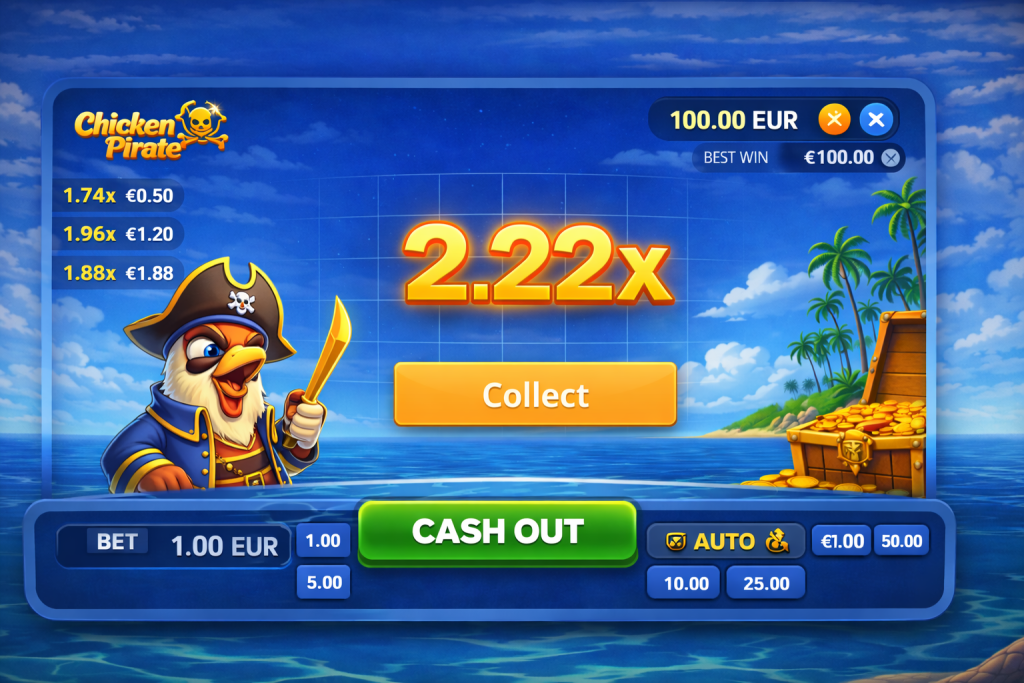
Chicken Pirate approaches RTP and volatility from a fundamentally different angle than traditional slot games. There are no reels, no paylines, and no fixed payout structure that determines outcomes at the moment a spin is completed. Instead, each round unfolds in real time through a rising multiplier that can stop at any point. The result is not revealed instantly. It develops, and that development is where the player becomes involved.
This shift changes how core characteristics should be interpreted. RTP still exists as a mathematical constant, but it is no longer experienced as a sequence of clearly defined wins and losses. It is distributed across a large number of rounds, each with a different lifespan and a different potential outcome. Some rounds end almost immediately, offering little room for decision. Others continue long enough to introduce tension between securing a result and risking further growth. The player is not simply observing the system. The player is interacting with it.
Volatility also takes on a more structural role. In most slots, it is described in terms of how often wins occur and how large they can be. In Chicken Pirate, it is expressed through the timing of events. It defines how frequently the multiplier is interrupted and how rarely it is allowed to extend into higher ranges. This creates a rhythm that is felt across the entire session rather than within isolated outcomes. Short sequences of early terminations, followed by occasional longer runs, form a pattern that cannot be reduced to a single label such as high or low.
The presence of selectable risk levels adds another layer to this system. Instead of a fixed volatility profile, the game offers multiple configurations that influence how aggressive or restrained the distribution becomes. This means that volatility is not only a descriptive characteristic but also a variable that shapes the overall behaviour of the game. RTP remains mathematically consistent, yet the way it is experienced can change depending on how that volatility is structured.
Understanding Chicken Pirate therefore requires a shift in perspective. RTP defines the long-term framework, volatility defines the rhythm of outcomes, and the player’s decisions determine how those two elements are encountered in practice. None of these components operates in isolation. The system only becomes clear when they are considered together.
The RTP Illusion: Why Return to Player Feels Different in Chicken Pirate
Why the Return Can Feel Different From the Number
In Chicken Pirate, the published RTP remains theoretical, while the session itself can feel very different from round to round. Frequent early crashes, occasional higher multipliers, and the length of play all influence how that percentage is actually perceived.
| Situation | How RTP Tends to Feel |
|---|---|
| Early crashes dominate | feels lower than expected |
| Mixed outcomes across the session | feels more balanced |
| Occasional high multipliers appear | feels more volatile |
| Longer play over many rounds | feels closer to the theoretical rate |
What this shows: the real mathematical RTP and the player’s perception of RTP are not always the same. In a crash-style game, short-term rhythm can easily feel harsher or smoother than the long-term percentage suggests.
Return to Player is often presented as a clear and reliable indicator of how a game behaves. In theory, it represents the percentage of stakes that is returned over a large number of rounds. In a system like Chicken Pirate, that clarity becomes less visible, not because the figure is inaccurate, but because the way outcomes are delivered is fundamentally different.
A traditional slot produces a complete result at the end of each spin. The player commits to a single action, and the system responds with a fixed outcome. In Chicken Pirate, the outcome is not delivered in a single moment. It unfolds through the movement of the multiplier, and that movement can be interrupted at any time. The return is therefore not experienced as a sequence of finished results, but as a series of developing situations.
Most rounds end early. The multiplier rises only briefly before it is stopped, creating frequent small or neutral outcomes. These early terminations dominate perception, especially in shorter sessions. Even when the theoretical return remains stable, the experience can feel restrictive because the player encounters a high concentration of minimal results before seeing any extended growth.
Longer multipliers do occur, but they are infrequent. Their rarity is essential for maintaining the overall balance of the system, yet they do not appear often enough to shape the immediate experience. This imbalance between frequent small outcomes and rare extended ones creates a disconnect between the mathematical RTP and how the game feels in practice.
Timing further complicates this perception. The same multiplier can lead to different results depending on when the player chooses to exit. Securing a lower value consistently produces a more stable pattern, while waiting for higher values introduces greater variability. Both approaches operate within the same RTP framework, yet they generate different impressions of the game. The percentage remains unchanged, but the path through it varies.
Because RTP is calculated over a large number of rounds, it does not describe short-term behaviour. A limited sequence of rounds can easily be dominated by variance, where clusters of early terminations or occasional extended runs distort the apparent balance. The theoretical return only becomes visible when these fluctuations have enough time to average out.
For this reason, RTP in Chicken Pirate should be understood as a background constant rather than a direct representation of the player’s experience. It defines the boundaries of the system, but it does not dictate how any individual session will unfold.
From Fixed Percentage to Dynamic Distribution: How RTP Is Actually Generated
How the Return Emerges from Event Distribution
In Chicken Pirate, RTP is not produced by one fixed type of win. It comes from the way different round endings are distributed across the multiplier curve, from very early stops to far less common extended runs.
Early crash
Most rounds end here. These short outcomes happen often and create the base layer of the distribution.
Mid zone
Some rounds survive longer and reach a more meaningful range, where the collect decision becomes more relevant.
High multiplier
Only a smaller share of rounds expands this far, which is why higher values feel unusual and more volatile.
What this shows: RTP is formed through the distribution of events, not through one repeating type of win. Frequent early endings, occasional middle outcomes, and rare higher multipliers all combine to shape the long-term return.
In Chicken Pirate, RTP is not produced through fixed payouts or predefined combinations. It emerges from a distribution of outcomes that vary in length, frequency, and value. Each round follows a multiplier that increases over time until it reaches a randomly determined endpoint. The position of that endpoint is what defines the result.
The majority of rounds terminate at low multipliers. These outcomes occur frequently and form the foundation of the system. A smaller portion extends into a middle range, where the multiplier grows enough to introduce meaningful decisions. Only a limited number reach higher values, where the potential return increases significantly but the likelihood decreases.
This layered structure is essential. Frequent early terminations stabilise the system and ensure that rounds resolve quickly. Mid-range outcomes introduce variability and decision-making pressure. Rare extended runs provide the necessary weight to balance the overall return. RTP is not generated by any single type of outcome, but by the interaction between all of them.
The multiplier itself represents potential value unfolding over time. As it increases, the opportunity to secure a higher return becomes more attractive, but the risk of losing the entire round also increases. This creates a continuous tension between securing a result and extending the round further. The player does not change the probabilities, but the player changes how those probabilities are experienced.
Randomness determines where each round ends, but it operates within a structured distribution designed to maintain consistency over the long term. Early endpoints are common, while extended ones are rare, yet both are necessary. Without frequent small outcomes, the system would lose stability. Without rare larger outcomes, the theoretical return could not be sustained.
RTP in this context is an emergent property. It arises from the cumulative effect of many rounds with different outcomes, rather than from a fixed set of rewards. The percentage remains stable in theory, but the way it is reached is shaped by variability, timing, and the structure of the multiplier.
Why RTP Cannot Be Measured in a Single Round or Session
A single round in Chicken Pirate represents only one point within a broad distribution of possible outcomes. It does not contain enough information to reflect the overall return. Whether the multiplier stops early or continues further, the result is isolated and cannot be used to interpret the system as a whole.
Short sessions face the same limitation. Because outcomes are unevenly distributed, clusters of similar results can occur. A sequence of early terminations may create the impression of consistent loss, while a few extended rounds may suggest the opposite. Both scenarios are possible within the same structure, and neither provides an accurate picture of the long-term return.
Variance dominates at smaller scales. It shapes perception by highlighting patterns that are temporary rather than structural. Only over a larger number of rounds do these fluctuations begin to balance out, allowing the theoretical RTP to emerge. Until that point, the experience is defined by irregularity rather than consistency.
This is why RTP should not be interpreted as a short-term indicator. It is a long-term measure that requires sufficient repetition to become meaningful. In Chicken Pirate, where outcomes vary significantly from one round to another, that requirement becomes even more important.
Understanding this distinction prevents misinterpretation. The system is not inconsistent, but it expresses its consistency over time rather than within isolated moments. RTP defines the framework, while volatility shapes how that framework is experienced in real time.
Volatility Reimagined: Not Risk, but Rhythm of the Multiplier
Volatility in Chicken Pirate cannot be reduced to a simple label such as high or low. While those terms may still appear in technical descriptions, they fail to capture how the game actually behaves. In this structure, volatility is not only about the size and frequency of outcomes. It is about the timing of interruption and the pace at which potential value develops.
Each round begins identically, but it does not progress identically. Some rounds end almost immediately, cutting off the multiplier before it has time to create meaningful value. Others continue just long enough to introduce tension, placing the player in a position where a decision must be made. A smaller number extend further, allowing the multiplier to reach higher levels, but these moments are not frequent enough to define the overall experience. Instead, they exist as rare extensions within a system dominated by early endings.
This creates a rhythm rather than a pattern. The game moves through sequences of short-lived rounds, occasionally interrupted by longer ones, without establishing a predictable flow. Volatility is therefore not simply the probability of large outcomes. It is the structure of time within which those outcomes can occur. It determines how often the player is given the opportunity to act and how often that opportunity is removed before it becomes significant.
Understanding volatility in this way shifts the focus from outcomes to behaviour. It is not only what the game pays, but how it unfolds. The frequent interruption of rounds creates a sense of pressure, while the rare extension of the multiplier introduces moments of potential. These two forces exist in constant tension, forming the core dynamic of the game.
Multiplier Zones: Where Volatility Actually Lives
Where Volatility Actually Happens Inside the Multiplier
Volatility in Chicken Pirate is not spread evenly across the round. It is concentrated in different stages of the multiplier, where each zone behaves differently and shapes the rhythm of the session.
What this shows: volatility lives inside the multiplier zones, not across the entire round equally. Each zone contributes differently to how the game unfolds.
The behaviour of volatility becomes clearer when the multiplier is viewed as a series of zones rather than a continuous line. Each zone represents a different stage of development, with its own characteristics and its own role within the overall distribution.
The earliest zone, typically between 1.00x and 1.50x, is where most rounds conclude. This is the area of frequent termination, where the multiplier rises briefly before being stopped. It defines the baseline experience of the game. Because this zone is encountered so often, it shapes perception more than any other. The player becomes accustomed to short rounds and limited progression, even though this is only one part of the system.
The middle zone, extending roughly from 1.50x to 3x, introduces a different dynamic. Here, the multiplier has developed enough to create meaningful choice. Exiting at this stage produces a moderate result, while continuing further increases both potential and risk. This zone is less common than the early stage, but it is where decision-making becomes central. It represents the transition between frequent outcomes and rare ones.
Beyond this lies the late zone, where the multiplier exceeds 3x and continues to grow. This area is defined by rarity. Reaching it requires a sequence of conditions that occur less frequently, and remaining within it involves increasing exposure to sudden termination. The potential value is significantly higher, but the likelihood of reaching and sustaining it is much lower. This imbalance is essential for maintaining the overall distribution.
These zones are not separate systems. They are interconnected layers of the same structure. Movement between them is continuous, but the probability of reaching each layer decreases as the multiplier rises. Volatility exists within this gradient, shaping how often each zone is encountered and how long the player remains within it.
Adjustable Risk Levels: Turning Volatility into a Game Variable
One of the defining features of Chicken Pirate is that volatility is not fixed. The game provides multiple risk levels that influence how the distribution of outcomes behaves. This transforms volatility from a passive characteristic into an active variable within the system.
Lower risk settings tend to allow more frequent progression into the middle zone. Early terminations still occur, but the distribution becomes less aggressive, creating a smoother flow of outcomes. The player encounters more opportunities to act, and the rhythm of the game becomes more stable. This does not remove variability, but it moderates its intensity.
Higher risk settings shift the balance in the opposite direction. Early terminations become more frequent, and extended runs become less predictable. The multiplier may still reach higher levels, but the path towards those levels becomes more restrictive. This creates a sharper contrast between short rounds and rare extended ones, increasing the perceived volatility of the session.
At the extreme end, the distribution becomes highly concentrated in early outcomes, with only occasional access to longer runs. This amplifies the tension between stability and potential, as most rounds resolve quickly while a small number offer significantly different possibilities. The experience becomes more fragmented, with fewer intermediate outcomes.
What remains constant across all these configurations is the underlying RTP. The mathematical return does not fundamentally change. What changes is the distribution through which that return is expressed. Lower risk settings distribute outcomes more evenly, while higher risk settings concentrate them into more extreme patterns.
This distinction is important because it separates expectation from experience. The same theoretical return can feel different depending on how volatility is structured. By adjusting risk levels, the player is not altering the long-term framework, but the way that framework is encountered within a session.
Volatility in Chicken Pirate is therefore not a static descriptor. It is a dynamic component that shapes the behaviour of the game in real time. It defines how often opportunities arise, how long they persist, and how they are distributed across the session. Understanding this dynamic is essential for interpreting how the game actually unfolds.
RTP vs Player Behaviour: The Same System, Different Outcomes
The structure of Chicken Pirate remains constant. The multiplier follows its curve, the crash point is determined by probability, and the overall RTP does not change. Yet the outcomes experienced by players can differ significantly. This difference does not come from the system itself, but from how it is engaged.
Two players can enter the same sequence of rounds and leave with completely different impressions. One may experience a relatively stable session, securing smaller multipliers and avoiding extended exposure. Another may encounter sharper fluctuations, waiting longer and accepting a higher risk of sudden loss. Both are operating within the same mathematical framework, but the way they move through it creates different results.
This distinction highlights an important principle. RTP defines the limits of the system, but it does not define the path taken within those limits. The player’s behaviour determines how often they interact with early outcomes, how frequently they reach the middle range, and how rarely they access higher multipliers. The system provides the structure, but the experience is shaped by how that structure is navigated.
In practical terms, this means that consistency is not built into the game. It is influenced by decisions. Frequent early exits create a pattern of smaller, more predictable results. Delayed exits introduce greater variability, as the player remains exposed to rounds that may end at any moment. Neither approach changes the underlying probabilities, but each produces a different interaction with those probabilities.
Because of this, the same RTP can feel stable or unstable depending on behaviour. It is not the percentage that changes, but the distribution of outcomes encountered by the player. The system remains neutral, while the experience becomes personal.
The Collect Decision: Where Volatility Becomes Personal
The moment of decision in Chicken Pirate is not at the start of the round, but during it. As the multiplier increases, the player must decide whether to secure the current value or continue in search of a higher one. This single action transforms volatility from a structural concept into a personal experience.
Exiting early reduces exposure to sudden termination. The multiplier is lower, but the result is secured before the round has time to collapse. Repeating this approach creates a sequence of modest outcomes, where variability is present but less pronounced. The session develops gradually, with fewer extreme fluctuations.
Remaining in the round for longer introduces a different dynamic. The multiplier continues to rise, increasing the potential return, but the risk of losing the entire round also increases. The longer the player waits, the narrower the margin becomes between securing a higher value and losing everything. This creates a sharper contrast between outcomes, where some rounds produce significantly more value and others produce none.
Between these two approaches lies a middle range, where the player balances exposure and security. Exiting at moderate multipliers produces outcomes that are neither minimal nor extreme, creating a more varied but controlled session. This balance does not eliminate volatility, but it distributes it more evenly.
What is important here is that volatility is not imposed entirely by the game. It is shaped by how long the player remains within each round. The same sequence of multiplier movements can lead to different results depending on when the exit occurs. Volatility becomes something that is not only observed, but experienced through timing.
Strategy Illusion: Why There Is No Fixed Way to “Beat” RTP
The presence of choice often creates the impression that a consistent method can be developed to control outcomes. In a system like Chicken Pirate, this impression is misleading. While behaviour influences experience, it does not alter the underlying probabilities that define the game.
Each round is independent, and the point at which it ends is not affected by previous decisions. Waiting longer in one round does not increase or decrease the likelihood of future outcomes. Exiting early does not create a pattern that can be exploited. The distribution remains constant, regardless of how it is approached.
This means that no single approach can consistently produce superior results over time. Early exits may reduce variability, but they also limit potential. Late exits may increase potential, but they also increase the frequency of complete losses. Balanced approaches distribute outcomes differently, but they do not change the overall return.
The idea of strategy in this context is therefore limited. It does not provide a way to overcome the system, but a way to interact with it. Different approaches lead to different experiences, but none of them alter the mathematical framework that defines RTP.
Understanding this prevents a common misunderstanding. Chicken Pirate is not a system that can be controlled through optimisation of decisions. It is a system that responds consistently to probability, while allowing variation in how that probability is experienced. The player can influence the path, but not the destination.
Recognising this distinction clarifies the role of behaviour within the game. It is not a tool for changing outcomes in a deterministic way, but a means of shaping how those outcomes are encountered. RTP remains constant, volatility remains structured, and the player moves between them without altering their fundamental relationship.
The Session Layer: Why RTP Only Exists Across Time
RTP is not a property of individual rounds. It is a property of accumulation. In Chicken Pirate, this distinction becomes especially important because each round represents only a small fragment of a much larger distribution. A single outcome, whether it ends early or extends further, carries no meaningful weight on its own. Only when many such outcomes are combined does the structure begin to reveal itself.
A session is therefore the first scale at which RTP becomes relevant. As rounds repeat, patterns begin to emerge. Early terminations remain frequent, mid-range developments appear intermittently, and occasional extended runs provide contrast. These elements do not occur in a fixed order, but over time they begin to balance each other. The theoretical return is not visible in isolated moments. It is formed gradually through repetition.
The length of the session plays a critical role in this process. Short sessions are dominated by variance, where clusters of similar outcomes can create misleading impressions. A sequence of early terminations may suggest a consistently restrictive system, while a few extended rounds may create the opposite perception. Neither reflects the underlying structure. They are temporary expressions of variability rather than indicators of the long-term return.
As the number of rounds increases, these fluctuations begin to even out. The distribution that defines RTP starts to take shape, not as a smooth progression, but as a balance between different types of outcomes. Stability is not achieved through uniform results, but through the interaction of frequent small events and rare larger ones. This balance cannot be observed instantly. It requires time.
The session layer therefore acts as a bridge between theory and experience. It is where the mathematical framework begins to intersect with what the player actually encounters. Without sufficient scale, RTP remains abstract. With enough repetition, it becomes a structural pattern rather than a theoretical concept.
Volatility Over Time: Flat Periods, Spikes, and Sudden Drops
How a Session Actually Moves From Calm to Shock
A Chicken Pirate session rarely develops in a smooth line. Most rounds stay near the lower part of the multiplier, then a few sudden extensions create sharp peaks before the curve falls back again.
Many rounds stay close to the lower multiplier range.
Some rounds rise much higher than the rest.
After peaks, values often fall back quickly.
What this shows: sessions move unevenly, with calm stretches, sharp peaks, and fast drops.
While RTP emerges gradually, volatility defines how that emergence feels. It shapes the texture of the session, determining whether outcomes appear smooth or uneven, predictable or fragmented. In Chicken Pirate, volatility is not expressed as a steady fluctuation. It appears in distinct phases that repeat without a fixed sequence.
Flat periods are characterised by frequent early terminations. The multiplier rises only briefly, and rounds conclude before meaningful development occurs. These sequences can extend across multiple rounds, creating a sense of stagnation. The system remains active, but progression is limited. This phase often dominates short-term perception because it is encountered most frequently.
Spikes represent the opposite condition. A round continues beyond the early stages and reaches a higher multiplier, producing a more substantial outcome. These events are less common, but they play a crucial role in balancing the distribution. They introduce moments of contrast, where the session briefly deviates from its more restrictive baseline.
Between these two phases lie transitional moments, where the multiplier enters the mid-range before resolving. These outcomes do not carry the same weight as extended runs, but they interrupt the monotony of flat periods. They contribute to the variability of the session without defining it.
Sudden drops connect all of these phases. Regardless of how far the multiplier has progressed, termination can occur at any point. This creates an environment where continuity is never guaranteed. Even a round that appears stable can end without warning, reinforcing the unpredictable nature of the system.
Over time, these elements combine to form a non-linear progression. The session does not move steadily towards a result. It shifts between phases, creating a pattern that is irregular but structurally consistent. Volatility is therefore not a momentary characteristic. It is a temporal structure that unfolds across the entire session.
When RTP and Volatility Intersect: The Complete Behavioural Model
RTP and volatility are often treated as separate characteristics, but in Chicken Pirate they are closely interconnected. RTP defines the long-term balance of the system, while volatility determines how that balance is distributed over time. Neither can be fully understood without the other.
RTP provides the mathematical boundaries within which all outcomes occur. It ensures that, over a sufficiently large number of rounds, the total return aligns with a fixed percentage. Volatility shapes how those rounds are experienced, influencing the frequency of early terminations, the occurrence of mid-range outcomes, and the rarity of extended runs.
The player operates within this intersection. Decisions do not alter RTP, and they do not change the underlying volatility profile. What they influence is the way these two elements are encountered. Exiting early aligns the player more closely with the frequent outcomes that stabilise the system. Waiting longer increases exposure to the less frequent outcomes that create contrast within the distribution.
This interaction creates a behavioural model rather than a fixed outcome structure. The system defines what is possible, volatility defines how often different possibilities occur, and the player determines how they engage with those possibilities. The result is not predetermined in a single moment, but shaped through continuous interaction.
Understanding this model clarifies the nature of the game. Chicken Pirate is not a sequence of isolated events, but a system in which mathematical consistency and experiential variability coexist. RTP ensures that the framework remains stable over time, while volatility ensures that the path towards that stability is uneven and dynamic.
The complete picture emerges only when these elements are viewed together. RTP without volatility would describe a system without movement. Volatility without RTP would describe movement without structure. Combined, they create a balanced yet unpredictable environment in which outcomes are distributed across time, and experience is shaped by both probability and choice.
Frequently Asked Questions About RTP and Volatility in Chicken Pirate
A System Defined by Structure, Not Outcome
Chicken Pirate does not present RTP and volatility as isolated characteristics. It integrates them into a system where both elements operate continuously and simultaneously. RTP defines the mathematical framework that governs long-term balance, while volatility determines how that balance is distributed across individual rounds and extended sessions.
The key difference lies in how these elements are experienced. RTP is not visible in single moments, and it cannot be measured through short-term results. It exists as a structural constant that only becomes apparent over time. Volatility, by contrast, is immediately felt. It shapes the rhythm of the game, defining how often rounds end early, how rarely they extend, and how unevenly outcomes are distributed.
The player operates within this intersection. Decisions do not alter the underlying probabilities, but they influence how those probabilities are encountered. Exiting early creates a more stable sequence of outcomes, while waiting longer increases exposure to sudden termination and rare extended runs. The system remains unchanged, but the experience varies.
Understanding Chicken Pirate therefore requires a shift away from outcome-based thinking. It is not a game where results are delivered in fixed packages or where a percentage can predict immediate behaviour. It is a system in which mathematical consistency and experiential variability coexist, each shaping the other over time.
RTP defines the boundaries, volatility defines the movement within those boundaries, and the player determines how that movement is navigated. Only when all three are considered together does the full structure of the game become clear.